Advertisements
Advertisements
Question
Use Lewis symbols to show electron transfer between the following atoms to form cations and anions:-
K and S
Advertisements
Solution 1
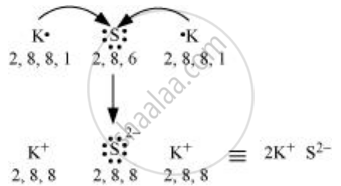
The electronic configurations of K and S are as follows:
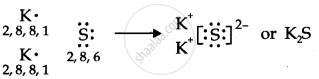
K: 2, 8, 8, 1
S: 2, 8, 6

Sulphur (S) requires 2 more electrons to complete its octet. Potassium (K) requires one electron more than the nearest noble gas i.e., Argon. Hence, the electron transfer can be shown as:
Solution 2
APPEARS IN
RELATED QUESTIONS
Explain the Formation of a Chemical Bond.
Write Lewis symbols for the following atoms and ions: S and S2–.
Write Lewis symbols for the following atoms and ions H and H–.
Draw Lewis dot diagram for the following.
Carbon dioxide (CO2)
Draw Lewis electron dot structure of C2H4
Draw Lewis electron dot structure of CF3Cl
Explain in brief with one example of an ionic bond.
Explain in brief with one example of a covalent bond
Which of the following molecules has a central atom with complete octet?
Which of the following is INCORRECT with respect to enthalpy?
In which of the following, the central atom does NOT have lone pair(s) of electrons?
Which of the following molecule does not obey octet rule?
Match the items given in Column I with examples given in Column II.
| Column I | Column II |
| (i) Hydrogen bond | (a) \[\ce{C}\] |
| (ii) Resonance | (b) \[\ce{LiF}\] |
| (iii) Ionic solid | (c) \[\ce{H2}\] |
| (iv) Covalent solid | (d) \[\ce{HF}\] |
| (e) \[\ce{O3}\] |
Assertion (A): Sodium chloride formed by the action of chlorine gas on sodium metal is a stable compound.
Reason (R): This is because sodium and chloride ions acquire octet in sodium chloride formation.
What is the formal charge present on the oxygen atom (numbered 1) in the Lewis structure of CO2?
\[\ce{^\bullet_\bullet {\ce{O}} ≡ C - \overset{\bullet\bullet}{\underset{\bullet\bullet}{O^\bullet_\bullet}}}\]
