Advertisements
Advertisements
Question
Use graph paper for this question.
The points A (2, 3), B (4, 5) and C (7, 2) are the vertices of A ABC.
- Write down the coordinates of A’, B’, C’ if Δ A’B’C’ is the image of Δ ABC, when reflected in the origin.
- Write down the co-ordinates of A”, B”, C” if A” B” C” is the image of Δ ABC, when reflected in the x-axis.
- Mention the special name of the quadrilateral BCC” B” and find its area.
Graph
Advertisements
Solution
(i) Reflection in origin
\[\ce{(x, y) ->[M0]=(-x, -y)}\]
∴ \[\ce{A(2, 3) ->[M0]= A'(-2, -3)}\]
\[\ce{B(4, 5) ->[M0]= B'(-4, -5)}\]
\[\ce{C(7, 2) ->[M0]= C'(-7, -2)}\]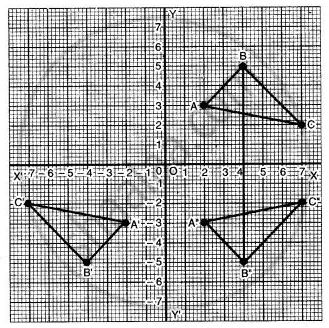
(ii) Now A, B, C is reflected in X axis.
Reflection in X axis
\[\ce{(x, y)->[Mx]=(x, -y)}\]
∴ \[\ce{A(2, 3)->[Mx]=A^"(2, -3)}\]
\[\ce{B(4, 5)->[Mx]=B^"(4, -5)}\]
\[\ce{C(7, 2)->[Mx]=C^"(7, -2)}\]
(iii) BCC"B" is an isosceles trapezium.
CD = 7 - 4 = 3
CC" = 2 + 2 = 4 and
BB" = 5 + 5 = 10
Area of Trapexium = `(1)/(2)` (CC" + BB") x CD
= `(1)/(2)` (10 + 4) x 3
= `(1)/(2)` x 14 x 3
= 21 sq. unit
shaalaa.com
Is there an error in this question or solution?
