Advertisements
Advertisements
Questions
Use Gauss' law to derive the expression for the electric field `(vecE)` due to a straight uniformly charged infinite line of charge density λ C/m.
Use Gauss' law to obtain an expression for the electric field due to an infinitely long thin straight wire with uniform linear charge density λ.
Advertisements
Solution
Field due to an infinitely long straight uniformly charged wire,
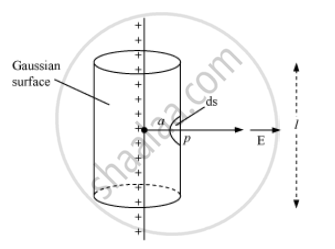
Consider a thin, infinitely long straight line charge of linear charge density λ.
Let P be the point at a distance a from the line. To find the electric field at point P, draw a cylindrical surface of radius ‘a’ and length l.
If E is the magnitude of the electric field at point P, then electric flux through the Gaussian surface,
Φ = E × Area of the curved surface of a cylinder of radius r and length l
As electric lines of force are parallel to the end faces (circular caps) of the cylinder, there is no component of the field along the normal to the end faces.
Φ = E × 2πal …(i)
According to Gauss's Theorem,
`phi = q/epsilon_0`
`∵ q = lambdal`
`:. phi = (lambdal)/epsilon_0` ...(ii)
From equations (i) and (ii), we get:
`E xx 2pial = (lambdal)/epsilon_0`
APPEARS IN
RELATED QUESTIONS
Explain why, for a charge configuration, the equipotential surface through a point is normal to the electric field at that point
A point charge of 2.0 μC is at the centre of a cubic Gaussian surface 9.0 cm on edge. What is the net electric flux through the surface?
A point charge causes an electric flux of −1.0 × 10³ Nm2/C to pass through a spherical Gaussian surface of 10.0 cm radius centred on the charge.
- If the radius of the Gaussian surface were doubled, how much flux would pass through the surface?
- What is the value of the point charge?
If the point charge is now moved to a distance 'd' from the centre of the square and the side of the square is doubled, explain how the electric flux will be affected.
A closed surface in vacuum encloses charges –q and +3q. The total electric flux emerging out of the surface is :
Two wires A and B of the same material and of equal length with the radii in the ratio 1 : 2 are subjected to identical loads. If the length of A increases by 8 mm, then the increase in length of B is:
A spherical ball contracts in volume by 0.02% when subjected to a pressure of 100 atmosphere. Assuming one atmosphere = 105 Nm−2, the bulk modulus of the material of the ball is:
The electric field inside a spherical shell of uniform surface charge density is ______.
- Obtain the expression for the electric field intensity due to a uniformly charged spherical shell of radius R at a point distant r from the centre of the shell outside it.
- Draw a graph showing the variation of electric field intensity E with r, for r > R and r < R.
Draw a graph of kinetic energy as a function of linear charge density λ.
