Advertisements
Advertisements
Question
Two thin converging lenses of focal lengths f1 and f2 are placed coaxially in contact. Derive expression for focal length of combination.
Advertisements
Solution
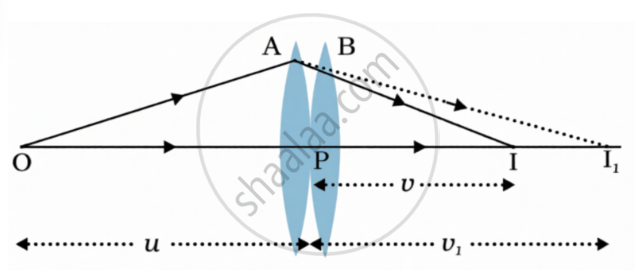
Two thin lenses, A and B (focal lengths f1, f2), are placed in contact with a common optical center P.
Lens A forms an image (I1) of the object O.
This image I1 acts as a virtual object for the second lens B.
Lens B then forms the final image at I.
Using the lens formula:
`1/v - 1/u = 1/f`
For lens A, the object distance is u, and the image distance is v1.
`1/v_1 - 1/u = 1/f_1` ...(1)
For the second lens, the image I1 produced by the first lens serves as a virtual object. For lens B, the object distance is v1, and the final image distance is v:
`1/v - 1/v_1 = 1/f_2` ...(2)
Adding equation (1) and equation (2):
`(1/v_1 - 1/u) + (1/v - 1/v_1) = 1/f_1 + 1/f_2`
`1/v - 1/u = 1/f_1 + 1/f_2` ...(3)
If the combination is replaced by a single lens of focal length F that forms an image of the same object at the same position, then:
`1/v - 1/u = 1/F`
Comparing this with equation (3), we get:
`1/F = 1/f_1 + 1/f_2`
`1/F = (f_1 + f_2)/(f_1f_2)`
F = `(f_1f_2)/(f_1 + f_2)`
Since the power of the combination is:
`P = 1/F`
The powers of the individual lenses are:
`P_1 = 1/f_1 and P_2 = 1/f_2`
We get,
P = P1 + P2
Thus, when two thin lenses are placed in contact, the power of the combination is equal to the algebraic sum of the powers of the individual lenses.
