Advertisements
Advertisements
Question
Two identical conductors 1 and 2 are placed on two frictionless conducting rails R and S in a uniform magnetic field directed vertically downward into the plane of the page. If conductor 1 is moved with a constant velocity in the direction as shown in figure, the force on conductor 2 will be along:
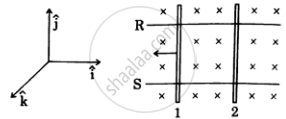
Options
`- hat i`
`- hat j`
`hat k`
`hat i`
Advertisements
Solution
`bb(hat i)`
Explanation:
Moving conductor 1 in a magnetic field induces an EMF (Motional EMF).
This EMF creates a current in the closed loop formed by the rails and conductor 2.
The induced current in conductor 2, which is in a magnetic field, experiences a magnetic force (Lorentz force).
Direction of induced current in conductor 1: `vec v xx vec B`
Force on conductor 2: `vec F = I(vec l xx vec B)`
Lenz’s Law: The system will try to oppose the change in flux.
Let `hat i` be right, `hat j` be up, and `hat k` be out of the page.
The magnetic field `vec B` is into the page, so `vec B = -B hat k`.
Conductor 1 moves right, so `vec v = v vec i`.
Induced current direction in 1 is `vec v xx vec B = (v hat i) xx (-B hat k)`
= `v B(hat i xx -hat k)`
= `v B(hat j)`
So current flows “up” in conductor 1. In the closed loop, this means current flows “down” through conductor 2.
For conductor 2, the length vector `vec l` is along `- hat j`.
Magnetic force on conductor 2: `vec F = I vec l xx vec B`
= `I(-L hat j) xx (-B hat k)`
= `I L B(hat j xx hat k)`
= `I L B hat i`
Alternatively, according to Lenz’s law, to oppose the increase in flux caused by moving 1 to the right, the loop will try to expand or contract. Here, the repulsive force between opposing currents in the parallel wires 1 and 2 will push conductor 2 to the right.
∴ The force on conductor 2 is along the `hat i` direction.
