English

Two cells of emf 1.5 Volt and 2 Volt having respective internal resistances of 1 Ω and 2 Ω are connected in parallel so as to send current in the same direction through an external resistance of 5 Ω.

Advertisements
Advertisements

Question

Two cells of emf 1.5 Volt and 2 Volt having respective internal resistances of 1 Ω and 2 Ω are connected in parallel so as to send current in the same direction through an external resistance of 5 Ω. Find the current through the external resistance.

Numerical
Advertisements

Solution

Given: E1 = 1.5 V, E2 = 2V, r1 = 1 Ω, r2 = 2 Ω, R = 5 Ω, I = ?

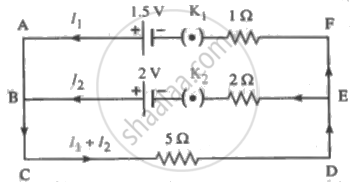
Let I1 and I2,  be the currents flowing through the two branches as shown in the following figure. The current through the 5 Ω resistor will be I1 + I[Kirchhoff's current law]. 

Applying Kirchhoff's voltage law to loop ABCDEFA, we get,

- (I1 + I2) R - I1r1 + E1 = 0

- (I1 + I2)5 - I1 + 1.5 = 0

- 5 I1 - 5 I2 - I1 = 1.5

- 6 I1 - 5 I2 = - 1.5

∴ 6 I1 + 5 I2 = 1.5       ....(1)

Applying Kirchhoff's voltage law to loop BCDEB, we get,

- (I1 + I2)R - I2r2 + E2 = 0

- (I1 + I2)5 - 2I2 + 2 = 0

- 5 I1 - 5 I2 - 2 I2 = - 2

- 5 I1 - 7 I2 = - 2

∴ 5I1 + 7I2 = 2       ....(2)

∴ Multiplying Eq. (1) by 5 and Eq. (2) by 6, we get,

6 I1 + 5 I2 = 1.5   ...(× 5)

5I1 + 7I2 = 2       ....(× 6)

30 I1 + 25 I2 = 7.5       ....(3)
30 I1 + 42 I2 = 12       ....(4)
-         -            -    
  17 I2 = 4.5

∴ I2 = `4.5/17` A

Substituting this value of I2 in Eq. (1), we get,

6 I1 + 5 I2 = 1.5

`6"I"_1 + 5 (4.5/17) = 1.5`

∴ `6"I"_1 + 22.5/17 = 1.5`

∴ `6"I"_1 = 1.5 - 22.5/17`

∴ `6"I"_1 = (25.5 - 22.5)/17`

∴ `6"I"_1 = 3/17`

∴ `"I"_1 = 3/(17 xx 6)`

∴ `"I"_1 = 0.5/17` A

Current through the 5 Ω resistance (external resistance) = `"I"_1 + "I"_2 = 0.5/17 + 4.5/17 = 5/17`A.

shaalaa.com
  Is there an error in this question or solution?
Chapter 9: Current Electricity - Exercises [Page 229]

APPEARS IN

Balbharati Physics [English] Standard 12 Maharashtra State Board
Chapter 9 Current Electricity
Exercises | Q 11 | Page 229

RELATED QUESTIONS

Kirchhoff’s first law, i.e., ΣI = 0 at a junction, deals with the conservation of ______.


Are Kirchhoff’s laws applicable to both AC and DC currents?


Kirchhoff’s second law (voltage law) is based on ______ 


State Kirchhoff’s first (current) law.


What is the basis of Kirchhoff’s current law and voltage law?


The figure shows a network of currents. The magnitude of currents is shown here. The current I will be ______


Kirchhoff's junction rule is a reflection of ____________.


The magnitude and direction of the current in the circuit shown will be ______


In the given circuit, the emf 'E' of the cell is ______.


What determines the conventional direction of the product of current and resistance while applying the Kirchhoff's law?


In the following electrical network, the value of 'I' is


The current in the arm CD of the circuit will be


The current I3 in the following circuit is ____________.


According the Kirchhoff's law, in any analytic circuit, if the direction of current is assumed opposite, then the value of current will be ____________.


Using Kirchhoff's law, find the current flowing through the given circuit.


Two cells of emf 4 V and 2 V having a respective internal resistance of 1 Ω and 2 Ω are connected in parallel, so as to send current in the same direction through an external resistance of 5 Ω. Find the current through the external resistance.


State Kirchhoff's voltage law.


State sign convention of Kirchhoff's voltage law.


State Kirchhoff's current law sign conventions


The figure shows part of an electric circuit. The potential difference VA - VB is ______. 


Which one of the following is the correct equation for the electric circuit shown in the figure?


In the following electrical network, the value of current I is:


Share
Notifications

Englishहिंदीमराठी


      Forgot password?
Use app×