Advertisements
Advertisements
Question
Three point masses, each of mass ‘m’ are kept at the corners of an equilateral triangle of side ‘L’. The system rotates about the center of the triangle without any change in the separation of masses during rotation. The period of rotation is directly proportional to `(cos 30° = (sqrt3)/2)` ______.
Options
`L^(3/2)`
L−2
L
`sqrtL`
Advertisements
Solution
Three point masses, each of mass ‘m’ are kept at the corners of an equilateral triangle of side ‘L’. The system rotates about the center of the triangle without any change in the separation of masses during rotation. The period of rotation is directly proportional to `(cos 30° = (sqrt3)/2) bbunderline(L^(3/2))`.
Explanation:
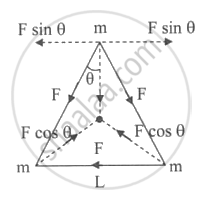
The gravitational force of attraction between any two masses is:
`F = (Gm^2)/L^2` ...(i)
Since the system rotates about the centre of the triangle, each mass performs circular motion.
∴ Centripetal force = gravitational force
∴ `(mv^2)/r = 2 F cos θ`
∴ `(mv^2)/r = 2 (Gm^2)/(L^2) cos θ`
∴ `(v^2)/r = 2 (Gm)/(L^2) cos θ`
∴ `(4pir^2)/(rT^2) = 2 (Gm^2)/(L^2) cos 30° ...(∵ v = rω = (2pir)/T)`
∴ `(4pir)/(T^2) = (Gm^2)/(L^2) xx sqrt3` ...(ii)
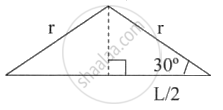
Now,
cos 30° = `(L/2)/r`
`r = L/(2 cos 30°)`
∴ `r = L/(sqrt3)` ...(iii)
Substituting equation (iii) in equation (ii)
`(4pi)/T^2 L/(sqrt3) = (GM)/(L^2) sqrt3`
∴ T2 ∝ L3
∴`T ∝ L^(3/2)`
