Advertisements
Advertisements
Question
There are two boxes, namely box-I and box-II. Box-I contains 3 red and 6 black balls. Box-II contains 5 red and 5 black balls. One of the two boxes, is selected at random and a ball is drawn at random. The ball drawn is found to be red. Find the probability that this red ball comes out from box-II.
Advertisements
Solution
Let E1 = Selecting Box-I
E2 = Selecting Box-II
A = Getting a red ball from the selected box
Here, P(E1) = `1/2`, P(E2) = `1/2`
`P(A/E_1) = 3/9 = 1/3`
`P(A/E_2) = 5/10 = 1/2`
Required probability = `P(E_2/A)`
= P(Red ball comes out from Box-II)
Using Bayes' theorem,
`P(E_2/A) = (P(E_2)P(A/E_2))/(P(E_1).P(A/E_1) + P(E_2).P(A/E_2))`
= `(1/2 xx 1/2)/(1/2 xx 1/3 + 1/2 xx 1/2)`
= `(1/4)/(1/6 + 1/4)`
= `(1/4)/(10/24)`
= `1/4 xx 24/10`
= `3/5`
Thus, probability that the red ball comes out form Box-II is `3/5`.
APPEARS IN
RELATED QUESTIONS
A bag contains 4 red and 4 black balls, another bag contains 2 red and 6 black balls. One of the two bags is selected at random and a ball is drawn from the bag which is found to be red. Find the probability that the ball is drawn from the first bag.
A manufacturer has three machine operators A, B and C. The first operator A produces 1% defective items, where as the other two operators B and C produce 5% and 7% defective items respectively. A is on the job for 50% of the time, B is on the job for 30% of the time and C is on the job for 20% of the time. A defective item is produced, what is the probability that was produced by A?
A card from a pack of 52 cards is lost. From the remaining cards of the pack, two cards are drawn and are found to be both diamonds. Find the probability of the lost card being a diamond.
Suppose a girl throws a die. If she gets 1 or 2 she tosses a coin three times and notes the number of tails. If she gets 3,4,5 or 6, she tosses a coin once and notes whether a ‘head’ or ‘tail’ is obtained. If she obtained exactly one ‘tail’, what is the probability that she threw 3,4,5 or 6 with the die ?
The contents of three urns are as follows:
Urn 1 : 7 white, 3 black balls, Urn 2 : 4 white, 6 black balls, and Urn 3 : 2 white, 8 black balls. One of these urns is chosen at random with probabilities 0.20, 0.60 and 0.20 respectively. From the chosen urn two balls are drawn at random without replacement. If both these balls are white, what is the probability that these came from urn 3?
A letter is known to have come either from LONDON or CLIFTON. On the envelope just two consecutive letters ON are visible. What is the probability that the letter has come from
(i) LONDON (ii) CLIFTON?
In a class, 5% of the boys and 10% of the girls have an IQ of more than 150. In this class, 60% of the students are boys. If a student is selected at random and found to have an IQof more than 150, find the probability that the student is a boy.
Three urns A, B and C contain 6 red and 4 white; 2 red and 6 white; and 1 red and 5 white balls respectively. An urn is chosen at random and a ball is drawn. If the ball drawn is found to be red, find the probability that the ball was drawn from urn A.
In a group of 400 people, 160 are smokers and non-vegetarian, 100 are smokers and vegetarian and the remaining are non-smokers and vegetarian. The probabilities of getting a special chest disease are 35%, 20% and 10% respectively. A person is chosen from the group at random and is found to be suffering from the disease. What is the probability that the selected person is a smoker and non-vegetarian?
For A, B and C the chances of being selected as the manager of a firm are in the ratio 4:1:2 respectively. The respective probabilities for them to introduce a radical change in marketing strategy are 0.3, 0.8 and 0.5. If the change does take place, find the probability that it is due to the appointment of B or C.
Three persons A, B and C apply for a job of Manager in a Private Company. Chances of their selection (A, B and C) are in the ratio 1 : 2 :4. The probabilities that A, B and C can introduce changes to improve profits of the company are 0.8, 0.5 and 0.3, respectively. If the change does not take place, find the probability that it is due to the appointment of C.
A diagnostic test has a probability 0.95 of giving a positive result when applied to a person suffering from a certain disease, and a probability 0.10 of giving a (false) positive result when applied to a non-sufferer. It is estimated that 0.5% of the population are sufferers. Suppose that the test is now administered to a person about whom we have no relevant information relating to the disease (apart from the fact that he/she comes from this population). Calculate the probability that: given a negative result, the person is a non-sufferer
2% of the population have a certain blood disease of a serious form: 10% have it in a mild form; and 88% don't have it at all. A new blood test is developed; the probability of testing positive is `9/10` if the subject has the serious form, `6/10` if the subject has the mild form, and `1/10` if the subject doesn't have the disease. A subject is tested positive. What is the probability that the subject has serious form of the disease?
A box contains three coins: two fair coins and one fake two-headed coin is picked randomly from the box and tossed. What is the probability that it lands head up?
A box contains three coins: two fair coins and one fake two-headed coin is picked randomly from the box and tossed. If happens to be head, what is the probability that it is the two-headed coin?
(Activity):
Mr. X goes to office by Auto, Car, and train. The probabilities him travelling by these modes are `2/7, 3/7, 2/7` respectively. The chances of him being late to the office are `1/2, 1/4, 1/4` respectively by Auto, Car, and train. On one particular day, he was late to the office. Find the probability that he travelled by car.
Solution: Let A, C and T be the events that Mr. X goes to office by Auto, Car and Train respectively. Let L be event that he is late.
Given that P(A) = `square`, P(C) = `square`
P(T) = `square`
P(L/A) = `1/2`, P(L/C) = `square` P(L/T) = `1/4`
P(L) = P(A ∩ L) + P(C ∩ L) + P(T ∩ L)
`="P"("A")*"P"("L"//"A") + "P"("C")*"P"("L"//"C") + "P"("T")*"P"("L"//"T")`
`= square * square + square * square + square * square`
`= square + square + square`
`= square`
`"P"("C"//"L") = ("P"("L" ∩ "C"))/("P"("L"))`
= `("P"("C") * "P"("L"//"C"))/("P"("L"))`
`= (square * square)/square`
`= square`
Solve the following:
The chances of P, Q and R, getting selected as principal of a college are `2/5, 2/5, 1/5` respectively. Their chances of introducing IT in the college are `1/2, 1/3, 1/4` respectively. Find the probability that IT is introduced in the college after one of them is selected as a principal
Solve the following:
The ratio of Boys to Girls in a college is 3:2 and 3 girls out of 500 and 2 boys out of 50 of that college are good singers. A good singer is chosen what is the probability that the chosen singer is a girl?
Suppose that 6% of the people with blood group O are left handed and 10% of those with other blood groups are left handed 30% of the people have blood group O. If a left handed person is selected at random, what is the probability that he/she will have blood group O?
Refer to Question 41 above. If a white ball is selected, what is the probability that it came from Bag 3
| CASE-BASED/DATA-BASED |
 |
| An insurance company believes that people can be divided into two classes: those who are accident prone and those who are not. The company’s statistics show that an accident-prone person will have an accident at some time within a fixed one-year period with a probability 0.6, whereas this probability is 0.2 for a person who is not accident prone. The company knows that 20 percent of the population is accident prone. |
Based on the given information, answer the following questions.
- What is the probability that a new policyholder will have an accident within a year of purchasing a policy?
- Suppose that a new policyholder has an accident within a year of purchasing a policy. What is the probability that he or she is accident prone?
Three persons A, B and C apply for a job a manager in a private company. Chances of their selection are in the ratio 1:2:4. The probability that A, B and C can introduce chances to increase the profits of a company are 0.8, 0.5 and 0.3 respectively. If increase in the profit does not take place, find the probability that it is due to the appointment of A.
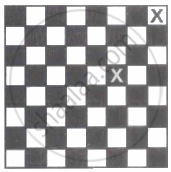
Let P denotes the probability of selecting one white and one black square from the chessboard so that they are not in the same row and also not in the same column (an example of this kind of the choice is shown in figure), then (1024)P is ______.
Why is Bayes' Theorem often called a method of finding reverse probability?
Which conditions are specified for the probabilities in Bayes' Theorem?
What does prior probability mean?
In a typical Bayes' Theorem question, what is usually given in the question statement?
