Advertisements
Advertisements
Question
There are three urns containing 2 white and 3 black balls, 3 white and 2 black balls, and 4 white and 1 black balls, respectively. There is an equal probability of each urn being chosen. A ball is drawn at random from the chosen urn and it is found to be white. Find the probability that the ball drawn was from the second urn.
Advertisements
Solution
We have 3 urns: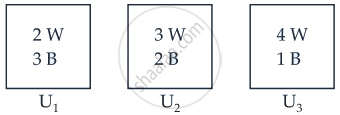
∴ Probabilities of choosing either of the urns are
P(U1) = P(U2) = P(U3) = `1/3`
Let H be the event of drawing white ball from the chosen urn.
∴ `"P"("H"/"U"_1) = 2/5`
`"P"("H"/"U"_2) = 3/5`
And `"P"("H"/"U"_3) = 4/5`
∴ `"P"("U"_2/"H") = ("P"("U"_2)*"P"("H"/"U"_2))/("P"("U"_1)*"P"("H"/"U"_1) + "P"("U"_2)*"P"("H"/"U"_2) + "P"("U"_3)*"P"("H"/"U"_3))`
= `(1/3*3/5)/(1/3*2/5 + 1/3*3/5 + 1/3*4/5)`
= `(3/5)/(2/5 + 3/5 + 4/5)`
= `3/9`
= `1/3`
Hence, the required probability is `1/3`.
