English

The value of cot[cos-1(725)] is ______. - Mathematics

Advertisements
Advertisements

Question

The value of `cot[cos^-1 (7/25)]` is ______.

Options

  • `25/24`

  • `25/7`

  • `24/25`

  • `7/24`

MCQ
Fill in the Blanks
Advertisements

Solution

The value of `cot[cos^-1 (7/25)]` is `7/24`.

Explanation:
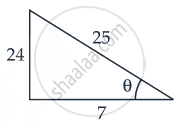
We have, `cot[cos^-1 (7/25)]`

Let `cos^-1  7/25` = θ

∴ cos θ = `7/25`

⇒ cot θ = `7/24`

∴  `cot[cos^-1 (7/25)] = cot[cot^-1  (7/24)] = 7/24`

shaalaa.com
  Is there an error in this question or solution?
Chapter 2: Inverse Trigonometric Functions - Exercise [Page 39]

APPEARS IN

NCERT Exemplar Mathematics [English] Class 12
Chapter 2 Inverse Trigonometric Functions
Exercise | Q 32 | Page 39

RELATED QUESTIONS

Prove that `sin^(-1) (3/5) + cos^(-1) (12/13) = sin^(-1) (56/65)`


if `tan^(-1) a + tan^(-1) b + tan^(-1) x = pi`, prove that a + b + c = abc 


Find the principal value of the following:

`tan^-1(-1/sqrt3)`


For the principal value, evaluate of the following:

`tan^-1{2sin(4cos^-1  sqrt3/2)}`


​Find the principal value of the following:

`cosec^-1(-sqrt2)`


​Find the principal value of the following:

cosec-1(-2)


For the principal value, evaluate the following:

`sec^-1(sqrt2)+2\text{cosec}^-1(-sqrt2)`


For the principal value, evaluate the following:

`cosec^-1(2tan  (11pi)/6)`


Find the principal value of the following:

`cot^-1(sqrt3)`


Find the principal value of the following:

`cot^-1(-1/sqrt3)`


Show that `"sin"^-1(5/13) + "cos"^-1(3/5) = "tan"^-1(63/16)`


Solve for x, if:

tan (cos-1x) = `2/sqrt5`


If `sin^-1"x" + tan^-1"x" = pi/2`, prove that `2"x"^2 + 1 = sqrt5`  


Prove that tan(cot–1x) = cot(tan–1x). State with reason whether the equality is valid for all values of x.


Find value of tan (cos–1x) and hence evaluate `tan(cos^-1  8/17)`


Find the value of `sin[2cot^-1 ((-5)/12)]`


The principal value branch of sec–1 is ______.


The value of `sin^-1 (cos((43pi)/5))` is ______.


The domain of sin–1 2x is ______.


Let θ = sin–1 (sin (– 600°), then value of θ is ______.


Find the value of the expression `sin(2tan^-1  1/3) + cos(tan^-1 2sqrt(2))`


The value of `sin^-1 [cos((33pi)/5)]` is ______.


If `cos(sin^-1  2/5 + cos^-1x)` = 0, then x is equal to ______.


The value of the expression `2 sec^-1 2 + sin^-1 (1/2)` is ______.


If tan–1x + tan–1y = `(4pi)/5`, then cot–1x + cot–1y equals ______.


The principal value of `cos^-1 (- 1/2)` is ______.


The value of cos (sin–1x + cos–1x), |x| ≤ 1 is ______.


The result `tan^1x - tan^-1y = tan^-1 ((x - y)/(1 + xy))` is true when value of xy is ______.


The value of the expression (cos–1x)2 is equal to sec2x.


The least numerical value, either positive or negative of angle θ is called principal value of the inverse trigonometric function.


The principal value of `sin^-1 [cos(sin^-1  1/2)]` is `pi/3`.


`"cos" ["tan"^-1 {"sin" ("cot"^-1  "x")}]` is equal to ____________.


If `"tan"^-1 ("a"/"x") + "tan"^-1 ("b"/"x") = pi/2,` then x is equal to ____________.


If `"tan"^-1 "x" + "tan"^-1"y + tan"^-1 "z" = pi/2, "x,y,x" > 0,` then the value of xy+yz+zx is ____________.


What is the value of x so that the seven-digit number 8439 × 53 is divisible by 99?


Evaluate `sin^-1 (sin  (3π)/4) + cos^-1 (cos π) + tan^-1 (1)`.


Share
Notifications

Englishहिंदीमराठी


      Forgot password?
Use app×