Advertisements
Advertisements
Question
The three scales below are perfectly balanced if • = 3. What are the values of ∆ and * ?
| a. |  |
| b. | 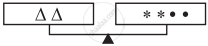 |
| c. | 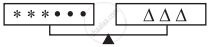 |
Advertisements
Solution
Given that • = 3 ...(i)
- 5* = 2Δ + 2• ...(ii)
- 2Δ = 2* + 2• ...(iii)
- 3* + 3• = 3Δ ...(iv)
Putting the value of (iii) in (ii), we get
5* = 2* + 2• + 2•
⇒ 5* – 2* = 4•
⇒ 3* = 4 × 3 ...[Using (i)]
⇒ * = `(4 xx 3)/3` = 4
Putting the value of * and • in (iv), we get
3 × 4 + 3 × 3 = 3Δ
⇒ 3Δ = 21
⇒ Δ = `21/3`
⇒ Δ = 7
APPEARS IN
RELATED QUESTIONS
Laxmi’s father is 49 years old. He is 4 years older than three times Laxmi’s age. What is Laxmi’s age?
The length of a rectangle is two times its breadth. Its perimeter is 60 cm.
The solution of the equation is ______.
If 5 is added to three times a number, it becomes the same as 7 is subtracted from four times the same number. This fact can be represented as ______.
A number is 7 more than one-third of itself.
Subramaniam and Naidu donate some money in a Relief Fund. The amount paid by Naidu is ₹ 125 more than that of Subramaniam. If the total money paid by them is ₹ 975, find the amount of money donated by Subramaniam.
In a school, the number of girls is 50 more than the number of boys. The total number of students is 1070. Find the number of girls.
Two times a number increased by 5 equals 9. Find the number.
After 20 years, Manoj will be 5 times as old as he is now. Find his present age.
In a bag, the number of one rupee coins is three times the number of two rupees coins. If the worth of the coins is ₹ 120, find the number of 1 rupee coins.
The sum of three consecutive integers is 5 more than the smallest of the integers. Find the integers.
