Advertisements
Advertisements
Question
The school auditorium was to be constructed to accommodate at least 1500 people. The chairs are to be placed in concentric circular arrangement in such a way that each succeeding circular row has 10 seats more than the previous one.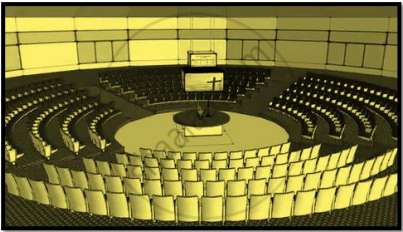
- If the first circular row has 30 seats, how many seats will be there in the 10th row?
- For 1500 seats in the auditorium, how many rows need to be there?
OR
If 1500 seats are to be arranged in the auditorium, how many seats are still left to be put after the 10th row? - If there were 17 rows in the auditorium, how many seats will be there in the middle row?
Advertisements
Solution
i. Since each row is increasing by 10 seats, so it is an AP with first term a = 30, and common difference d = 10.
So number of seats in 10th row = a10 = a+ 9d
= 30 + 9 × 10
= 120
ii. Sn = `n/2 (2a + (n - 1)d)`
1500 = `n/2 (2 xx 30 + (n - 1)10)`
3000 = 50n + 10n2
n2 + 5n – 300 = 0
n2 + 20n – 15n – 300 = 0
(n + 20) (n – 15) = 0
Rejecting the negative value, n = 15
OR
No. of seats already put up to the 10th row = S10
S10 = `10/2` {2 × 30 + (10 – 1)10}
= 5(60 + 90)
= 750
So, the number of seats still required to be put is 1500 – 750 = 750
iii. If no. of rows = 17
Then the middle row is the 9th row
a8 = a + 8d
= 30 + 80
= 110 seats
