Advertisements
Advertisements
Question
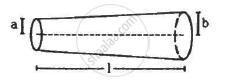
The following figure shows a conductor of length l with a circular cross-section. The radius of the cross-section varies linearly from a to b. The resistivity of the material is ρ. Assuming that b – a << l, find the resistance of the conductor.
Advertisements
Solution
Let us consider a small element strip of length dx at a distance x from one end, as shown below.
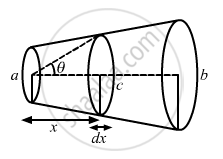
Let the resistance of the small element strip be dR. Let the radius at that point be c .
Then, the resistance of this small strip,
\[dR = \frac{\rho dx}{\pi c^2} .............(1)\]
\[\tan\theta = \frac{c - a}{x} = \frac{b - a}{L}\]
\[ \Rightarrow \frac{c - a}{x} = \frac{b - a}{L}\]
\[ \Rightarrow L \times \left( c - a \right) = x \times \left( b - a \right)\]
\[ \Rightarrow Lc - La = xb - xa\]
Differentiating w.r.t to x, we get:-
\[L\frac{dc}{dx} - 0 = b - a \]
\[ dx = \frac{Ldc}{\left( b - a \right)} ...........(2)\]
Substituting the value of dx in equation (1), we get:-
\[dR = \frac{\rho Ldc}{\pi c^2 \left( b - a \right)}\]
\[dR = \frac{\rho L}{\pi\left( b - a \right)} \cdot \frac{dc}{c^2}\]
Integrating dR from a to b, we get:-
\[\int_0^R dR = \frac{\rho L}{\pi\left( b - a \right)} \int_a^b \frac{dc}{c^2}\]
\[ \Rightarrow R = \frac{\rho L}{\pi\left( b - a \right)} \left[ \frac{- 1}{c} \right]_a^b \]
\[ = \frac{\rho L}{\pi\left( b - a \right)}\left( \frac{- 1}{b} - \frac{- 1}{a} \right)\]
\[ = \frac{\rho L}{\pi ab}\]
