Advertisements
Advertisements
Question
The following diagrams are the age pyramids of different populations. Comment on the status of these populations.

Advertisements
Solution
Fig.A: It is a ‘pyramid’ shaped age pyramid. In this figure, the base i.e pre- reproductive stage is very large when compared with the reproductive and past reproductive stages of the population. This type of age structure indicates that the population would increase rapidly.
Fig.B: It is an ‘inverted bell’ shaped pyramid. In this figure, the pre-reproductive and reproductive stages are the same. This type of age structure indicates that the population is stable.
Fig.C: It is ‘Urn’ shaped pyramid. In this figure, the pre-reproductive and reproductive stages are less than the post-reproductive stage of this population. In this population more older people are present. This type of age structure indicates that the population definitely is declining.
APPEARS IN
RELATED QUESTIONS
Construct an age pyramid which reflects a stable growth status of human population.
Represent diagrammatically three kinds of age-pyramids for human populations.
How does an age pyramid for human population at given point of time helps the policy-makers in planning for future.
List the attributes that populations but not individuals possess.
What is reproductive fitness? Explain it with the help of an example.
Answer the following question.
What is "population" according to you as a biology student?
Answer the following question.
"The size of a population for any species is not a static parameter." Justify the statement with specific reference to fluctuations in the population density of a region in a given period of time.
Study the flow chart given below and complete the equation that follows by identifying 1, 2, 3 and 4.
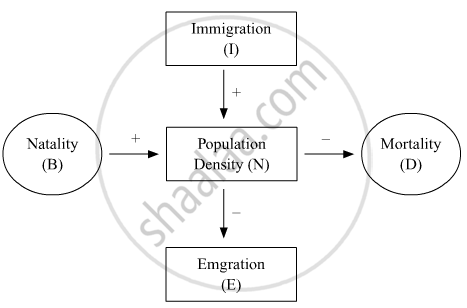
Nt + 1 = Nt + {(1+ 2) − (3 + 4)}
Animals that can move from fresh water to sea called as ________.
Nutrient enrichment of water body result.
Population having large number of postreproductive and small number of prereproductive age group is called
`"dN"/"dt" = "rN" (("K"- "N")/"K")` in logistic growth "K" represents:
The density of a population in a habitat per unit area is measured in different units. Write the unit of measurement against the following:
Bacteria
An individual and a population has certain characteristics. Name these attributes with definitions.
Given below is the Age Pyramid of the population in one of the states in India as per 2011 census. It depicts the male population on the left-hand side, female population on the right-hand side, newborns towards the base and gradually increasing age groups as we move from base to the top, with the oldest population at the top. Study this pyramid and comment upon the appropriateness of the Assertion and the Reason.

Percentage to the total population
Assertion: It is a stable population.
Reason: The pre-reproductive and reproductive individuals are almost in equal numbers and the post-reproductive individuals are relatively fewer.
Important attributes belonging to a population but not to an individual are:
- Birth rate and death rate
- Male and female
- Birth and death
- Sex-ratio
Select the correct option from the given options:
The number of lily plants in a pond was found to be 50. After one year, the number. increased to 65. Calculate the natality of lily plants.
