Advertisements
Advertisements
Question
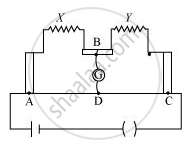
The figure shows experimental set up of a meter bridge. When the two unknown resistances X and Y are inserted, the null point D is obtained 40 cm from the end A. When a resistance of 10 Ω is connected in series with X, the null point shifts by 10 cm. Find the position of the null point when the 10 Ω resistance is instead connected in series with resistance ‘Y’. Determine the values of the resistances X and Y.
Advertisements
Solution
For a metre bridge:
`X/Y = l_1/(100 - l_1)`… (1)
Where, it is given that l1 = 40 cm
`X/Y = 40/(100 -40) = 2/3`… (2)
When 10 Ω resistance is added in series to X, null point shifts by 10 cm.
`(X+10)/Y = (40+10)/(100 - (40 +10))`
`X +10 = 50/50`
`(X+10)/Y = 1 or X+10 = Y ..... (3)`
Substituting the value of X from equation (2), we obtain
`2/3y+10 = Y`
`10 = Y -2/3 Y`
or
`Y/3 =10`
`Y =30 Omega`
Substituting the value of Y in equation (3), we obtain
X + 10 = 30
X = 20 Ω
Position of the null point when 10 Ω resistance is put in series with Y,
`20/(30+10) = l_i/(100 - l_i)`
`2000 - 20l_1 = 40l_1`
`60l_1 = 2000`
`l_1 = 2000/60`
`l_1 = 33.3 cm`
APPEARS IN
RELATED QUESTIONS
State any ‘two’ possible sources of errors in meter-bridge experiment. How can they be minimised?
A cell balances against a length of 200 cm on a potentiometer wire, when it is shunted by a resistance of 8Ω. The balancing length reduces by 40 cm, when it is shunted by a resistance of 4 Ω . Calculate the balancing length when the cell is in open circuit. Also calculate the internal resistance of the cell.
Why is it generally preferred to obtain the balance point in the middle of the meter bridge wire?
Which material is used for the meter bridge wire and why?
A resistance of R Ω draws current from a potentiometer as shown in the figure. The potentiometer has a total resistance Ro Ω. A voltage V is supplied to the potentiometer. Derive an expression for the voltage across R when the sliding contact is in the middle of the potentiometer.

Write the principle of working of a metre bridge
In a metre bridge, the balance point is found at a distance l1 with resistances R and S as shown in the figure.An unknown resistance X is now connected in parallel to the resistance S and the balance point is found at a distance l2. Obtain a formula for X in terms of l1, l2 and S.

In a meter bridge, the null point is found at a distance of l1 cm from A. If now a resistance of X is connected in parallel with S, the null point occurs at l2 cm. Obtain a formula for X in terms of l1, l2 and S.

Two resistances are connected in the two gaps of a meter bridge. The balance points is 20 cm from the zero end. When resistance of 15 ohm is connected in series with the smaller of the two resistances, the null point shifts to 40 cm. The smaller of the two resistances has the value (in ohm) ______.
