Advertisements
Advertisements
Question
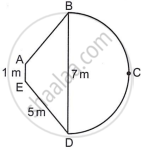
The figure alongside represents the horizontal cross-section of a pond. ABDE is an isosceles trapezium in which AE = 1 m, ED = 5 m, BD = 7 m. BCD is a semicircle on diameter BD. The sides of the pond are vertical and the depth of the water in the pond is 50 cm. Find the volume of water in the pond.
Advertisements
Solution
We have,
The figure alongside represents the horizontal cross-section of a pond.
ABDE is an isosceles trapezium in which AE = 1 m, ED = 5 m, BD = 7 cm.
BCD is a semicircle on diameter BD.
The sides of the pond are vertical and the depth of the water in the pond is 50 cm.
Now draw perpendiculars AM and EN on BD,
Then, BM = 3 m, DN = 3 m and MN = 1 m
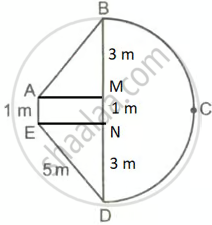
Now, in ΔABM
By Pythagoras theorem
AB2 = AM2 + BM2
52 = AM2 + 33
AM2 = 25 – 9 = 16
AM = 4 m
Similarly, EN = 4 m
Area of trapezium ABDE is `1/2 (AE + BD) xx AM`
= `1/2 1 + 7 xx 4`
= 16 m2
And the area of semicircle BCD is `1/2 π(r)^2`
= `1/2 xx 22/7 xx 7/2 xx 7/2`
= 19.25 m2
Then the area of the given cross-section
= Area of trapezium ABDE + Area of semicircle BCD
= 16 + 19.25
= 35.25 m2
Now volume of the water in the pond
= (Area of the given cross-section) × (Depth of the water in the pond)
= `35.25 xx 50/100 m^3` ...`[∵ 1 cm = 1/100 m]`
= 17.625 m3
