Advertisements
Advertisements
Question
The equation of electromotive force for an electric circuit containing resistance and self-inductance is E = `"Ri" + "L" "di"/"dt"`, where E is the electromotive force is given to the circuit, R the resistance and L, the coefficient of induction. Find the current i at time t when E = 0
Advertisements
Solution
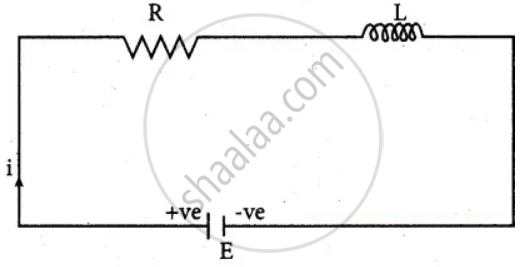
By voltage law
`"Ri" + "L" "i"/"dt"` = E
÷ By L, `"Ri"/"L" + "di"/"dt" = "E"/"L"`
`"di"/"t" + "R"/"L" "i" = "E"/"L"` ........(1)
This is a linear differential equation.
Integrating factor I.F = `"e"^(int "R"/"L" "dt")`
= `"e"^("R"/"L" "t")`
Its solution is given by
`"i" "e"^("R"/"L" "i") = int "E"/"L" "e"^("R"/"L" "t") "dt" + "c"`
`"i" "e"^("R"/"L" "i") = "E"/"L" xx "L"/"R" "e"^("R"/"L" "t") + "c"`
`"i" "e"^("R"/"L" "i") = "E"/"L" "e"^("R"/"L" "t") + "c"`
Divided by `"e"^("R"/"L" "t")`
i = `"E"/"R" + "e"^(- "Rt"/"L")`
At time t find i when E = 0
i = `0/12 + "Ce"^(- "Rt"/"L")`
i = `"Ce"^(- "Rt"/"L")`
APPEARS IN
RELATED QUESTIONS
The rate of increase in the number of bacteria in a certain bacteria culture is proportional to the number present. Given that the number triples in 5 hours, find how many bacteria will be present after 10 hours?
Find the population of a city at any time t, given that the rate of increase of population is proportional to the population at that instant and that in a period of 40 years the population increased from 3,00,000 to 4,00,000
The engine of a motor boat moving at 10 m/s is shut off. Given that the retardation at any subsequent time (after shutting off the engine) equal to the velocity at that time. Find the velocity after 2 seconds of switching off the engine
Suppose a person deposits ₹ 10,000 in a bank account at the rate of 5% per annum compounded continuously. How much money will be in his bank account 18 months later?
Assume that the rate at which radioactive nuclei decay is proportional to the number of such nuclei that are present in a given sample. In a certain sample, 10% of the original number of radioactive nuclei have undergone disintegration in a period of 100 years. What percentage of the original radioactive nuclei will remain after 1000 years?
Water at temperature 100°C cools in 10 minutes to 80°C at a room temperature of 25°C. Find the temperature of the water after 20 minutes
Water at temperature 100°C cools in 10 minutes to 80°C at a room temperature of 25°C. Find the time when the temperature is 40°C `[log_"e" 11/15 = - 0.3101; log_"e" 5 = 1.6094]`
At 10.00 A.M. a woman took a cup of hot instant coffee from her microwave oven and placed it on a nearby kitchen counter to cool. At this instant, the temperature of the coffee was 180°F and 10 minutes later it was 160°F. Assume that the constant temperature of the kitchen was 70°F. What was the temperature of the coffee at 10.15 AM? `|log 9/100 = - 0.6061|`
At 10.00 A.M. a woman took a cup of hot instant coffee from her microwave oven and placed it on a nearby kitchen counter to cool. At this instant, the temperature of the coffee was 180°F and 10 minutes later it was 160°F. Assume that the constant temperature of the kitchen was 70°F. The woman likes to drink coffee when its temperature is between130°F and 140°F. between what times should she have drunk the coffee? `|log 6/11 = - 0.2006|`
A pot of boiling water at 100°C is removed from a stove at time t = 0 and left to cool in the kitchen. After 5 minutes, the water temperature has decreased to 80° C and another 5 minutes later it has dropped to 65°C. Determine the temperature of the kitchen
Choose the correct alternative:
The integrating factor of the differential equation `("d"y)/("d"x) + y = (1 + y)/lambda` is
Choose the correct alternative:
The solution of the differential equation `("d"y)/("d"x) = 2xy` is
Choose the correct alternative:
P is the amount of certain substance left in after time t. If the rate of evaporation of the substance is proportional to the amount remaining, then
Choose the correct alternative:
If the solution of the differential equation `("d"y)/("d"x) = ("a"x + 3)/(2y + f)` represents a circle, then the value of a is
