Advertisements
Advertisements
Question
The difference of the square of two natural numbers is 45. The square of the smaller number is 4 times the larger number. Determine the numbers.
Advertisements
Solution
Let these two numbers be X and Y, Y being the bigger number. Then as per the question,
Y2 - X2 =45 ..... (i)
X2 = 4Y ..... (ii)
From (i), we get X2=Y2- 45, Putting this in (ii), we get
Y2 - 45 - 4Y = O
⇒ Y2 - 4Y- 45 = 0
⇒ Y2 - 9Y + 5Y - 45 = 0
⇒ Y (Y - 9) + 5( Y - 9) = 0
⇒ (Y-9) (Y+S) = 0
⇒ Y can't be a negative number and hence Y=9
⇒ Putting Y = 9 in (ii), we get X2 = 4 x 9=36
⇒ X = 6
Hence numbers are 6 and 9.
APPEARS IN
RELATED QUESTIONS
Solve the following quadratic equations by factorization:
`sqrt2x^2-3x-2sqrt2=0`
Solve the following quadratic equations by factorization:
`x^2 + (a + 1/a)x + 1 = 0`
For the equation given below, find the value of ‘m’ so that the equation has equal roots. Also, find the solution of the equation:
x2 – (m + 2)x + (m + 5) = 0
A two digit number is such that the product of its digit is 8. When 18 is subtracted from the number, the digits interchange its place. Find the numbers.
Solve equation using factorisation method:
`x = (3x + 1)/(4x)`
A car covers a distance of 400 km at a certain speed. Had the speed been 12 km/hr more, the time taken for the journey would have been 1 hour 40 minutes less. Find the original speed of the car.
Solve the following equation by factorization
`(1)/(x - 3) - (1)/(x + 5) = (1)/(6)`
Solve the following equation by factorisation :
x2 + 6x – 16 = 0
Is 0.2 a root of the equation x2 – 0.4 = 0? Justify
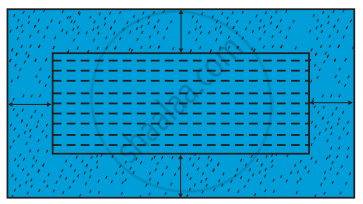
In the centre of a rectangular lawn of dimensions 50 m × 40 m, a rectangular pond has to be constructed so that the area of the grass surrounding the pond would be 1184 m2 [see figure]. Find the length and breadth of the pond.