Advertisements
Advertisements
Question
The diagram represents the cross-sections of a loft PQRST, PTQ is an isosceles triangle and QRST is a rectangle.
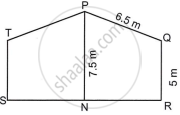
The height PN of P above the ground is 7.5 m. The height QR is 5 m and PQ is 6.5 m. Given that N is the mid-point of SR, find the length of SR and the area of PQRST.
Advertisements
Solution
Given:
- PQRST is a loft where PTQ forms an isosceles triangle and QRST forms a rectangle.
- Height PN height of point P above ground = 7.5 m
- Height QR height of rectangle QRST = 5 m
- PQ = 6.5 m
- N is the midpoint of SR.
We need to find:
- The length of SR
- The area of the entire loft PQRST.
Step 1: Understanding the figure and labeling
Since QRST is a rectangle and QR = 5 m height, then SR is the base of the rectangle and lies on the ground.
N is the midpoint of SR, so N divides SR into two equal segments.
PTQ is an isosceles triangle with PQ = PT = 6.5 m.
The height PN from P to line SR is 7.5 m.
Since N is midpoint of SR, triangles PNT and PNQ are right triangles.
Step 2: Find the half length of SR using right triangle PNT or PNQ
In triangle PNQ,
PN = 7.5 m ...(Height)
PQ = 6.5 m ...(Equal side)
Use Pythagoras theorem to find NQ half of SR:
PQ2 = PN2 + NQ2
(6.5)2 = (7.5)2 + NQ2
42.25 = 56.25 + NQ2
NQ2 = 42.25 – 56.25
NQ2 = –14 ...(Which is not possible)
There is a mistake here; since the hypotenuse PQ = 6.5 is less than height PN = 7.5 m, this is contradictory.
Reviewing given data typically, in an isosceles triangle with vertex P and base TQ on the ground, the height from P to TQ should be less than side PQ.
Therefore, reassess the triangle is PQ the side or the base?
Given PTQ is isosceles triangle with equal sides PT and PQ = 6.5 m each and base TQ unknown.
Assuming N is midpoint of SR and QRST is rectangle with height QR = 5 m, so SR is horizontal base line.
Since N is midpoint of SR and PN = 7.5 m is height from point P to SR, the vertical distance between P and SR is 7.5 m.
Point Q is directly above R with height 5 m; thus, Q lies 5 m above R.
So point Q has a height of 5 m and point P has height 7.5 m, meaning vertical distance between P and Q in same horizontal position vertically is 2.5 m.
Step 3: Determine length of NQ = ?
From PQ = 6.5 m, in triangle PNQ:
PN = 7.5 m
PQ = 6.5 m
NQ = ?
Use Pythagoras:
PQ2 = PN2 + NQ2
6.52 = 7.52 + NQ2
42.25 = 56.25 + NQ2
NQ2 = 42.25 – 56.25
NQ2 = –14
Negative value implies triangle configuration not right angled with PN perpendicular to SR at N.
Instead, from the figure, PN is perpendicular to SR, so PN ⊥ SR. So in triangle PNS, PN is height.
So we must consider a right triangle with hypotenuse PT or PQ.
Recognize that since PTQ is isosceles with PT = PQ, then base TQ can be found.
Step 4: Use triangle PTQ properties to find base TQ
By the properties of an isosceles triangle with vertex P and PT = PQ = 6.5 m, height PN = 7.5 m from P to SR midpoint N of base SR, we use the distance from N to T or Q to find half the base TQ.
Since N is midpoint of SR and QRST is rectangle with height 5 and base SR to be found.
Step 5: Calculate half base TQ using triangle PNT right triangle
In the right triangle PNT,
PN = 7.5 m ...(Height)
PT = 6.5 m ...(Hypotenuse)
Find NT half TQ:
NT2 = PT2 – PN2
= 6.52 – 7.52
= 42.25 – 56.25
= –14 ...(Not possible)
This reinforces that height PN = 7.5 m is higher than side PT = 6.5 m, causing contradiction.
Step 6: Review problem assumptions and data
Since height PN (7.5 m) is greater than PQ or PT (6.5 m), this is impossible for a triangle.
Alternatively, perhaps PN is the height of P above the ground (SR) and height QR = 5 m is height of rectangle, so point Q lies 5 m above R.
Since N is midpoint of SR, and height from P to N is 7.5 m, the vertical difference P and Q is 7.5 – 5 = 2.5 m.
So, vertical projection of P to Q is 2.5 m.
Distance between P and Q is 6.5 m.
Let the horizontal distance between N and Q be x.
Use Pythagoras in triangle PNQ:
PQ2 = PNQ2 + NQ2
6.52 = (2.5)2 + x2
42.25 = 6.25 + x²
x2 = 36
x = 6 m
So NQ = 6 m
Step 7: Since N is midpoint of SR and QRST is rectangle
SR = 2 × NQ
= 2 × 6
= 12 m
Step 8: Calculate area of PQRST
Area of rectangle QRST = base SR × height QR
= 12 m × 5 m
= 60 m2
Area of triangle PTQ = 0.5 × base TQ × height PN above base TQ
Length of TQ = 2 × NQ
= 2 × 6
= 12 m
Height of triangle P above TQ is PN – QR
Height = 7.5 m – 5 m
Height = 2.5 m? No.
Because TQ is at height 5 m, P is at 7.5 m.
So height of triangle PTQ above base TQ is P height – Q height
= 7.5 – 5
= 2.5 m
So area of triangle PTQ
= 0.5 × base TQ × height
= 0.5 × 12 × 2.5
= 15 m2
Step 9: Total area of PQRST
= Area of rectangle QRST + Area of triangle PTQ
= 60 m2 + 15 m2
= 75 m2
Length of SR = 12 m
Area of PQRST = 75 m2
