Advertisements
Advertisements
Question
The density of turpentine is 840 kg/m3. What will be its relative density ? (Density of water = 1000 kg/m3)
Advertisements
Solution
`"Relative density" = "Density of turpentine"/"Density of water"`
= `(840 "kg/m"^3)/(1000 "kg/m"^3)`
= 0.84
Ans: Relative density of turpentine = 0.84.
APPEARS IN
RELATED QUESTIONS
What is the density of a substance of mass 100 g and volume 10 cm3 ?
5 kg of material A occupy 20 cm3 whereas 20 kg of materia! B occupy 90 cm3. Which has the greater density : A or B ? Support your answer with calculations.
A piece of steel has a volume of 12 cm3, and a mass of 96 g. What is its density in g/cm3 ?
A piece of steel has a volume of 12 cm3, and a mass of 96 g. What is its density in kg/m3 ?
A metal in which even iron can float is :
The relative densities of four liquids P, Q, R and S are 1.26, 1.0, 0.84 and 13.6 respectively. An object is floated in all these liquids, one by one. In which liquid the object will float with its maximum volume submerged under the liquid?
A solid of density 900 kg/m3 floats in oil as shown in the given diagram. The oil floats on water of density 1000 kg/m3 as shown. The density of oil kg/m3 could be :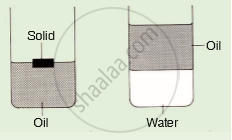
Numerical Problem.
Density of mercury is 13600 kg m–3. Calculate the relative density.
Calculate the average density of the earth in terms of g, G and R
A cube of side 5 cm is immersed in water and then in a saturated salt solution. In which case will it experience a greater buoyant force. If each side of the cube is reduced to 4 cm and then immersed in water, what will be the effect on the buoyant force experienced by the cube as compared to the first case for water. Give a reason for each case.
