Advertisements
Advertisements
Question
The area of the circle x2 + y2 = 16 enterior to the parabola y2 = 6x is
Options
- \[\frac{4}{3}\left( 4\pi - \sqrt{3} \right)\]
- \[\frac{4}{3}\left( 4\pi + \sqrt{3} \right)\]
- \[\frac{4}{3}\left( 8\pi - \sqrt{3} \right)\]
- \[\frac{4}{3}\left( 8\pi + \sqrt{3} \right)\]
MCQ
Advertisements
Solution
\[\frac{4}{3}\left( 8\pi - \sqrt{3} \right)\]
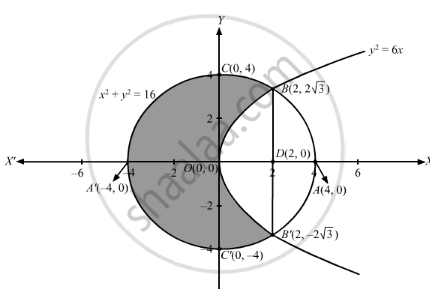
Points of intersection of the parabola and the circle is obtained by solving the simultaneous equations
\[x^2 + y^2 = 16\text{ and }y^2 = 6x\]
\[ \Rightarrow x^2 + 6x = 16 \]
\[ \Rightarrow x^2 + 6x - 16 = 0\]
\[ \Rightarrow \left( x + 8 \right)\left( x - 2 \right) = 0\]
\[ \Rightarrow x = 2\text{ or }x = - 8 \]
\[x\text{ can not be - 8 as in this case it will be the point outside circle . }\]
\[ \therefore x = 2\]
\[ \therefore\text{ When }x = 2, y = \pm \sqrt{6 \times 2} = \pm \sqrt{12} = \pm 2\sqrt{3}\]
\[ \therefore B\left( 2 , 2\sqrt{3} \right)\text{ and }B'\left( 2 , - 2\sqrt{3} \right)\text{ are points of intersection of the parabola and circle . }\]
\[\text{ Required area = Area }\left( OB'C'A'CBO \right) =\text{ area of circle - area }\left( OBAB'O \right) \]
\[\text{ Area of circle with radius }4 = \pi \times 4^2 = 16\pi \]
Now,
\[\text{ Area }\left( OBAB'O \right) = 2\text{ area }\left( OBAO \right)\]
\[ = 2\left[\text{ area }\left( OBDO \right) +\text{ area }\left( DBAD \right) \right]\]
\[ = 2 \times \left[ \int_0^2 \sqrt{6x} dx + \int_2^4 \sqrt{16 - x^2} dx \right]\]
\[ = 2 \times \left\{ \left[ \sqrt{6}\frac{x^\frac{3}{2}}{\frac{3}{2}} \right]_0^2 + \left[ \frac{x}{2}\sqrt{16 - x^2} + \frac{1}{2} \times 16 \sin^{- 1} \left( \frac{x}{4} \right) \right]_2^4 \right\}\]
\[ = 2 \times \left\{ \left( \sqrt{6} \times \frac{2}{3} \times 2^\frac{3}{2} - 0 \right) + \left( \frac{1}{2}4\sqrt{16 - \left( 4 \right)^2} + \frac{1}{2} \times 16 \sin^{- 1} \frac{4}{4} - \frac{2}{2}\sqrt{16 - 2^2} - \frac{1}{2} \times 16 \sin^{- 1} \frac{2}{4} \right) \right\}\]
\[ = 2 \times \left[ \left( \sqrt{6} \times \frac{2}{3} \times 2\sqrt{2} \right) + 0 + 8 \sin^{- 1} \left( 1 \right) - \sqrt{12} - 8 \sin^{- 1} \left( \frac{1}{2} \right) \right]\]
\[ = 2 \times \left[ \frac{8\sqrt{3}}{3} + 8 \times \frac{\pi}{2} - 2\sqrt{3} - 8\frac{\pi}{6} \right]\]
\[ = 2 \left\{ \frac{8\sqrt{3} - 6\sqrt{3}}{3} + 8\left( \frac{\pi}{2} - \frac{\pi}{6} \right) \right\}\]
\[ = 2\left\{ \frac{2\sqrt{3}}{3} + 8\left( \frac{2\pi}{6} \right) \right\}\]
\[ = \frac{4\sqrt{3}}{3} + \frac{16\pi}{3}\]
\[\text{ Shaded area }= 16\pi - \left( \frac{4\sqrt{3}}{3} + \frac{16\pi}{3} \right)\]
\[ = \frac{48\pi - 16\pi}{3} - \frac{4\sqrt{3}}{3}\]
\[ = \frac{32\pi}{3} - \frac{4\sqrt{3}}{3}\]
\[ = \frac{4}{3}\left( 8\pi - \sqrt{3} \right)\text{ sq units }\]
Points of intersection of the parabola and the circle is obtained by solving the simultaneous equations
\[x^2 + y^2 = 16\text{ and }y^2 = 6x\]
\[ \Rightarrow x^2 + 6x = 16 \]
\[ \Rightarrow x^2 + 6x - 16 = 0\]
\[ \Rightarrow \left( x + 8 \right)\left( x - 2 \right) = 0\]
\[ \Rightarrow x = 2\text{ or }x = - 8 \]
\[x\text{ can not be - 8 as in this case it will be the point outside circle . }\]
\[ \therefore x = 2\]
\[ \therefore\text{ When }x = 2, y = \pm \sqrt{6 \times 2} = \pm \sqrt{12} = \pm 2\sqrt{3}\]
\[ \therefore B\left( 2 , 2\sqrt{3} \right)\text{ and }B'\left( 2 , - 2\sqrt{3} \right)\text{ are points of intersection of the parabola and circle . }\]
\[\text{ Required area = Area }\left( OB'C'A'CBO \right) =\text{ area of circle - area }\left( OBAB'O \right) \]
\[\text{ Area of circle with radius }4 = \pi \times 4^2 = 16\pi \]
Now,
\[\text{ Area }\left( OBAB'O \right) = 2\text{ area }\left( OBAO \right)\]
\[ = 2\left[\text{ area }\left( OBDO \right) +\text{ area }\left( DBAD \right) \right]\]
\[ = 2 \times \left[ \int_0^2 \sqrt{6x} dx + \int_2^4 \sqrt{16 - x^2} dx \right]\]
\[ = 2 \times \left\{ \left[ \sqrt{6}\frac{x^\frac{3}{2}}{\frac{3}{2}} \right]_0^2 + \left[ \frac{x}{2}\sqrt{16 - x^2} + \frac{1}{2} \times 16 \sin^{- 1} \left( \frac{x}{4} \right) \right]_2^4 \right\}\]
\[ = 2 \times \left\{ \left( \sqrt{6} \times \frac{2}{3} \times 2^\frac{3}{2} - 0 \right) + \left( \frac{1}{2}4\sqrt{16 - \left( 4 \right)^2} + \frac{1}{2} \times 16 \sin^{- 1} \frac{4}{4} - \frac{2}{2}\sqrt{16 - 2^2} - \frac{1}{2} \times 16 \sin^{- 1} \frac{2}{4} \right) \right\}\]
\[ = 2 \times \left[ \left( \sqrt{6} \times \frac{2}{3} \times 2\sqrt{2} \right) + 0 + 8 \sin^{- 1} \left( 1 \right) - \sqrt{12} - 8 \sin^{- 1} \left( \frac{1}{2} \right) \right]\]
\[ = 2 \times \left[ \frac{8\sqrt{3}}{3} + 8 \times \frac{\pi}{2} - 2\sqrt{3} - 8\frac{\pi}{6} \right]\]
\[ = 2 \left\{ \frac{8\sqrt{3} - 6\sqrt{3}}{3} + 8\left( \frac{\pi}{2} - \frac{\pi}{6} \right) \right\}\]
\[ = 2\left\{ \frac{2\sqrt{3}}{3} + 8\left( \frac{2\pi}{6} \right) \right\}\]
\[ = \frac{4\sqrt{3}}{3} + \frac{16\pi}{3}\]
\[\text{ Shaded area }= 16\pi - \left( \frac{4\sqrt{3}}{3} + \frac{16\pi}{3} \right)\]
\[ = \frac{48\pi - 16\pi}{3} - \frac{4\sqrt{3}}{3}\]
\[ = \frac{32\pi}{3} - \frac{4\sqrt{3}}{3}\]
\[ = \frac{4}{3}\left( 8\pi - \sqrt{3} \right)\text{ sq units }\]
shaalaa.com
Is there an error in this question or solution?
