Advertisements
Advertisements
Question
Suppose you have three resistors, each of value 30 Ω. List all the different resistances you can obtain using them.
Advertisements
Solution
(a) When the three resistors are connected in series:-
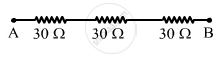
The resultant resistance, Req = R + R + R = 90 Ω
(b) When the three resistors are connected in parallel:-
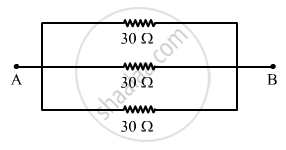
The resultant resistance of the combination,
\[\frac{1}{R_{eq}} = \frac{1}{R} + \frac{1}{R} + \frac{1}{R} = \frac{3}{R} = \frac{3}{30} = \frac{1}{10}\]
\[\Rightarrow R_{eq} = 10\Omega\]
(c) When two of the resistors are connected in parallel and this combination is connected in series with the third resistor:-

Let R' be the resultant resistance of the two resistors connected in parallel to each other. Therefore,
\[\frac{1}{R'} = \frac{1}{R} + \frac{1}{R} = \frac{2}{R} = \frac{2}{30} = \frac{1}{15}\]
\[\Rightarrow R' = 15 \Omega\]
Now, the net resistance of the combination of the resistors,
Req = R' + R = 15 + 30 = 45 Ω
(d) When two of the resistors are connected in series and the combination is connected to the third resistor in parallel:-

Let R' be the resultant resistance of the series in combination. Therefore,
R' = R + R = 30 + 30 = 60 Ω
Now, let the net resultant of the combination be Req. So,
\[\frac{1}{R_{eq}} = \frac{1}{R'} + \frac{1}{R} = \frac{1}{60} + \frac{1}{30} = \frac{3}{60} = \frac{1}{20}\]
\[\Rightarrow R_{eq} = 20 \Omega\]
