Advertisements
Advertisements
Question
Suppose the wages of labourers in an economy are low because of excess supply of labour. In order to help the labourers, the government enacts a legislation to fix minimum wages above the equilibrium level as determined by the free play of the market forces of demand and supply. Explain the implications of such a policy with the help of an appropriate diagram.
Advertisements
Solution
The floor price is set by the government to encourage producers to supply more by guaranteeing them a minimum acceptable price for their goods. In India, such prices are commonly fixed for essential agricultural products like wheat and rice, and also for minimum wages for labourers.
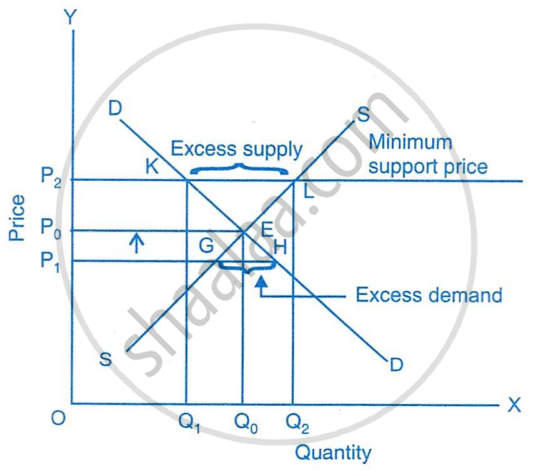
In the diagram, E is the equilibrium point where the demand curve (DD) and supply curve (SS) intersect, resulting in equilibrium price OP0 and equilibrium quantity OQ0. If the government sets a minimum price below equilibrium (at OP1), it has no impact on the market because the market price (OP0) is already higher. However, when a minimum price is set above the equilibrium (at OP2), it becomes effective. At this higher price, producers are willing to supply OQ2, but consumers demand only OQ1, creating a surplus or excess supply equal to Q1Q2 (also shown as KL in the diagram). This mismatch leads to unsold goods, which often requires government intervention, such as purchasing the surplus stock.
