Advertisements
Advertisements
Question
Study the picture and answer the following questions:
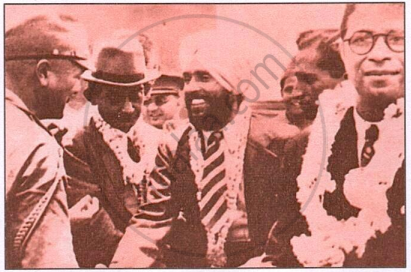
- Identify the person in the picture and name the army formed by him. How was this army formed and where?
- What were the objectives of this army? Did it achieve its objectives?
- Mention this army’s contribution to India’s freedom struggle.
Very Long Answer
Advertisements
Solution
- Identification and Formation of the Army:
- Identification: The prominent figure on the right, wearing glasses, is Netaji Subhas Chandra Bose, alongside General Mohan Singh (in the turban).
- Name of the Army: The army shown is the Indian National Army (INA) or the Azad Hind Fauj.
- Where and How it was Formed: It was officially formed in Singapore in 1942. Following the British surrender in Singapore, the Japanese forces captured thousands of Indian soldiers of the British Army. The Japanese handed over these Prisoners of War (POWs) to Captain Mohan Singh, who motivated and organised them into an independent military unit to fight for India’s freedom.
- Objectives and Achievements:
- Objectives of the INA:
- To launch an armed revolution against British rule to secure complete independence.
- To establish a Provisional Government of Free India (Azad Hind Government).
- To mobilise Indian manpower, funds, and resources living in East Asia.
- To march into India with the war cry “Chalo Dilli!”.
- Achieve its objectives: While the INA failed militarily to capture Delhi due to the ultimate defeat of Japan in World War II, it successfully achieved its political and emotional objectives. It destroyed the blind loyalty of Indian soldiers toward the British Empire and ignited a fierce wave of patriotism across mainland India.
- Objectives of the INA:
- Contribution to India’s Freedom Struggle:
- Broke the Loyalty of the Armed Forces: The INA proved to the British that they could no longer rely on Indian soldiers to sustain their colonial rule. This directly inspired the historic Royal Indian Navy (RIN) Mutiny of 1946, which forced the British to accelerate their departure.
- The Red Fort Trials Upsurge: When the British put INA officers (Sahgal, Dhillon, and Nawaz) on trial at the Red Fort, it created an unprecedented wave of mass political awakening, protests, and national unity across the country.
- Exemplary Communal Harmony: The INA set a brilliant example of national integration, as soldiers and officers from all religions, Hindus, Muslims, Sikhs, and Christians lived, ate, and fought side-by-side for a common cause.
- Internationalised the Freedom Movement: By forming a provisional government recognised by multiple global nations, Netaji and the INA turned India’s domestic freedom struggle into an international diplomatic issue.
shaalaa.com
Is there an error in this question or solution?
