Advertisements
Advertisements
Question
State with reason whether you agree or disagree with the following statement:
When the price of Giffen goods falls, the demand for it increases.
Options
Agree
Disagree
Advertisements
Solution
I disagree with the statement.
Reason:
When the price of Giffen goods falls, the demand for them decreases. Inferior goods, or low-quality goods, are those goods whose demand does not rise even if their price falls. At times, demand decreases when the price of such commodities falls. Sir Robert Giffen observed this behaviour in England in relation to bread declined; people did not buy more because of an increase in their real income or purchasing power. They preferred to buy superior goods, like meat. This is known as Giffen's paradox.
APPEARS IN
RELATED QUESTIONS
Explain briefly anyone determinant of an exceptional demand curve.
Distinguish between:
Inferior goods and superior goods
Statements that explain Giffen’s paradox:
- It is an exception to the law of demand.
- It is applicable to inferior or low quality goods.
- Demand increases when the prices of inferior goods fall
- It was identified by Prof. Alfred Marshall.
State with reason whether you agree or disagree with the following statement:
When the prices of Giffen goods falls, demand for such goods rises.
State with reason whether you agree or disagree with the following statement:
There are no exceptions to the law of demand.

Questions:
- Demand Curve D1D1indicates ______ (1m)
- Demand Curve D2D2indicates______ (1m)
- Name the above diagram and explain. (2m)
 |
 |
Questions:
- Diagram’ A ‘represents _____in demand (1m)
- Diagram ‘B’ represents _____in demand (1m)
- In diagram ‘A’ movement of demand curve is in_____ direction (1m)
- In diagram ‘B’ movement of demand curve is in______ direction (1m)
PASSAGE
Mona visits a shopping mall near her residence. She shops for monthly groceries which include rice, wheat, sugar, cooking oil and pulses. She purchases additional quantities of sugar much more than her monthly requirement anticipating that prices may rise in the coming days due to festivities.
She observes two different qualities of tur dal out of which one quality is inferior and the other is superior. She does not purchase the low quality tur dal even though its price is comparatively lower. Instead she prefers to buy superior quality tur dal.
- Identify the exception to the law of demand in the given passage with reference to purchase of additional quantities of sugar much more than monthly requirement anticipating that prices may rise in the coming days due to festivities (1mark)
- Identify the kind of good with reference to low quality tur dal (1mark)
- Express your personal opinion based on the above information. (2 marks)
State with reason whether you agree or disagree with the following statement:
When price of Giffen goods fall, the demand for it increases.
State with reasons whether you agree or disagree with the following statement:
There is a direct relationship between the price of Giffen goods and its demand.
State with reason whether you agree or disagree with the following statement.
When price of Giffen goods fall, the demand for it increases.
State with reasons whether you agree or disagree with the following statement:
When price of Giffen goods fall, the demand for it increases.
State with reason whether you agree or disagree with the following statements:
When price of Giffen goods fall, the demand for it increases.
State with reason whether you agree or disagree with the following statement:
When price of Giffen goods fall, the demand for it increases.
‘Price is an indicator of quality.’ The statement applies to ______.
When price of Giffen goods fall, the demand for it increases.
State with reason whether you agree or disagree with the following statement:
When price of Giffen goods fall, the demand for it increases.
In which exception to the law of demand does the consumer equate price and quality.
“The inverse relationship between price and quantity demanded does not hold good in many cases.”
- Justify the above as Yes or No.
- If justified, explain in brief the Giffen Effect.
State with reasons whether you agree or disagree with the following statement:
When price of Giffen goods fall, the demand for it increases.
Mention one exception to the law of demand. Give one point only.
What is contraction in demand?
State two circumstances under which the demand curve slopes upwards to the right.
Give one point each of similarity and dissimilarity between Giffen goods and Veblen goods.
What are Giffen goods?
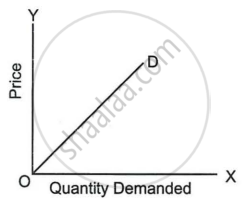
Explain the following diagram with reference to the concept of Giffen goods.
Why are prestige good an exception to the law of demand?
Which of the following best describes a Giffen good?
Why do people buy more luxury goods when prices go up, defying the usual law of demand?
Which exception to the law of demand is primarily based on consumer beliefs about product quality?
What happens to the demand for necessities like salt or electricity when their prices increase?
Which situation is an example of speculation affecting demand?
