Advertisements
Advertisements
Question
State whether the following statement is true or false. Give reasons for your answer :
When the equilibrium price is greater than the market price there will be excess supply in the market.
Options
True
False
Advertisements
Solution
True, when equilibrium price is greater than market price there will be excess supply in the market.
Explanation: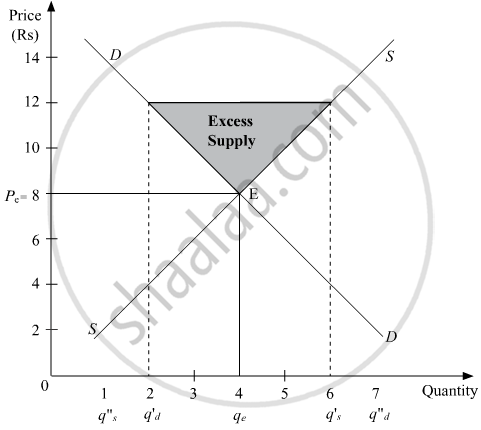
For example, let us suppose that the price of a good is Rs 12 (which is higher than the equilibrium price of Rs 8), and at this price, only 2 units of output are demanded, while as per the market supply curve SS, the producers are ready to sell 6 units of output. As the market supply is more than the market demand, so there is a situation of excess supply by 4 units (i.e. 6 –2 = 4 units). This excess supply will increase competition among the sellers; consequently, they will reduce the price in order to sell more of their output. The fall in price will continue until the price becomes Rs 8, where market demand equals market supply.
APPEARS IN
RELATED QUESTIONS
Determination of equilibrium price under perfect competition.
If the prevailing market price is above the equilibrium price, explain its chain of effects.
Explain the chain of effects of excess supply of a good on its equilibrium price
Explain the chain of an effect of excess demand of a good on it equilibrium price.
Explain the meaning of excess demand and excess supply with the help of a schedule. Explain their effect on equilibrium price.
Distinguish between Gross domestic product at a market price and Gross domestic product at factor cost.
Equilibrium price of an essential medicine is too high. Explain what possible steps can be taken to bring down the equilibrium price but only through the market forces. Also explain the series of changes that will occur in the market.
Define or Explain the General equilibrium.
At what level of price do the firms in a perfectly competitive market supply when free entry and exit is allowed in the market? How is the equilibrium quantity determined in such a market?
If the price of a substitute Y of good X increases, what impact does it have on the equilibrium price and quantity of good X?
Explain the following concept:
Price discrimination
Define or explain the following concept:
Equilibrium price
Suppose the demand and supply equations of a commodity X in a perfectly competitive market are given by :
Qd = 1700 – 2P
Qs = 1300 + 3P
Calculate the value of equilibrium price and equilibrium quantity of the commodity X.
The diagram given below shows the change in price of cotton shirts. Which one of the following causes the equilibrium price to move from P1 to P2?

