Advertisements
Advertisements
Question
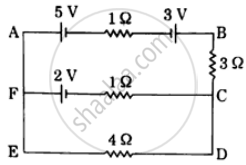
State Kirchhoff’s rules. Using those rules, find the current flowing through branch FC in the given circuit.
Advertisements
Solution
- Kirchhoff’s Junction Rule (Current Law): The algebraic sum of currents at any junction is zero (∑I = 0). This is based on the conservation of charge.
- Kirchhoff’s Loop Rule (Voltage Law): The algebraic sum of changes in potential around any closed loop is zero (∑∆V = 0). This is based on the conservation of energy.
We use the loop rule for independent loops or nodal analysis (derived from Kirchhoff’s laws). Let the potential at junctions A, F, and E be 0 V (ground).
Let the potential at node B be VB and at node C be VC.
From the diagram, the branch AB has a 5V battery (positive left), a 1 Ω resistor, and a 3 V battery (positive right).
Applying the Junction Rule at node B:
`(V_B - (0 + 5 - 3))/1 + (V_B - V_C)/3` = 0
`V_B - 2 + (V_B - V_C)/3` = 0
⇒ 3VB − 6 + VB − VC = 0
⇒ 4VB − VC = 6 ...(i)
Applying the Junction Rule at node C:
The branch FC has a 2 V battery (positive left) and a 1 Ω resistor. The branch CD/ED has a 4 Ω resistor.
`(V_C - V_B)/3 + (V_C - (0 + 2))/1 + (V_C - 0)/4` = 0
Multiply the entire equation by 12:
4(VC − VB) + 12(VC − 2) + 3VC = 0
4VC − 4VB + 12VC − 24 + 3VC = 0
⇒ −4VB + 19VC = 24 ...(ii)
Adding equations (i) and (ii):
(4VB − VC) + (−4VB + 19VC) = 6 + 24
18VC = 30
⇒ VC = `30/18`
= `5/3` V
Current flowing through branch FC (IFC) from F to C:
IFC = `(V_F + 2 - V_C)/1`
= `(0 + 2 - 5//3)/1`
= `2 - 5/3`
= `1/3` A
∴ The current flowing through branch FC is `1/3` A directed from F towards C.
