Advertisements
Advertisements
Question
Starting with same initial conditions an ideal gas expands from volume \[V_A\] to \[V_B\] in three different ways. The work done by the gas is '\[W_1\]' if the process is purely adiabatic, '\[W_2\]' if it is purely isobaric and '\[W_3\]' if it is purely isothermal. Then ______.
Options
\[W_1>W_2>W_3\]
\[W_1<W_2<W_3\]
\[W_2>W_3>W_1\]
\[W_2<W_3<W_1\]
Advertisements
Solution
Starting with same initial conditions an ideal gas expands from volume \[V_A\] to \[V_B\] in three different ways. The work done by the gas is '\[W_1\]' if the process is purely adiabatic, '\[W_2\]' if it is purely isobaric and '\[W_3\]' if it is purely isothermal. Then \[W_2>W_3>W_1\].
Explanation:
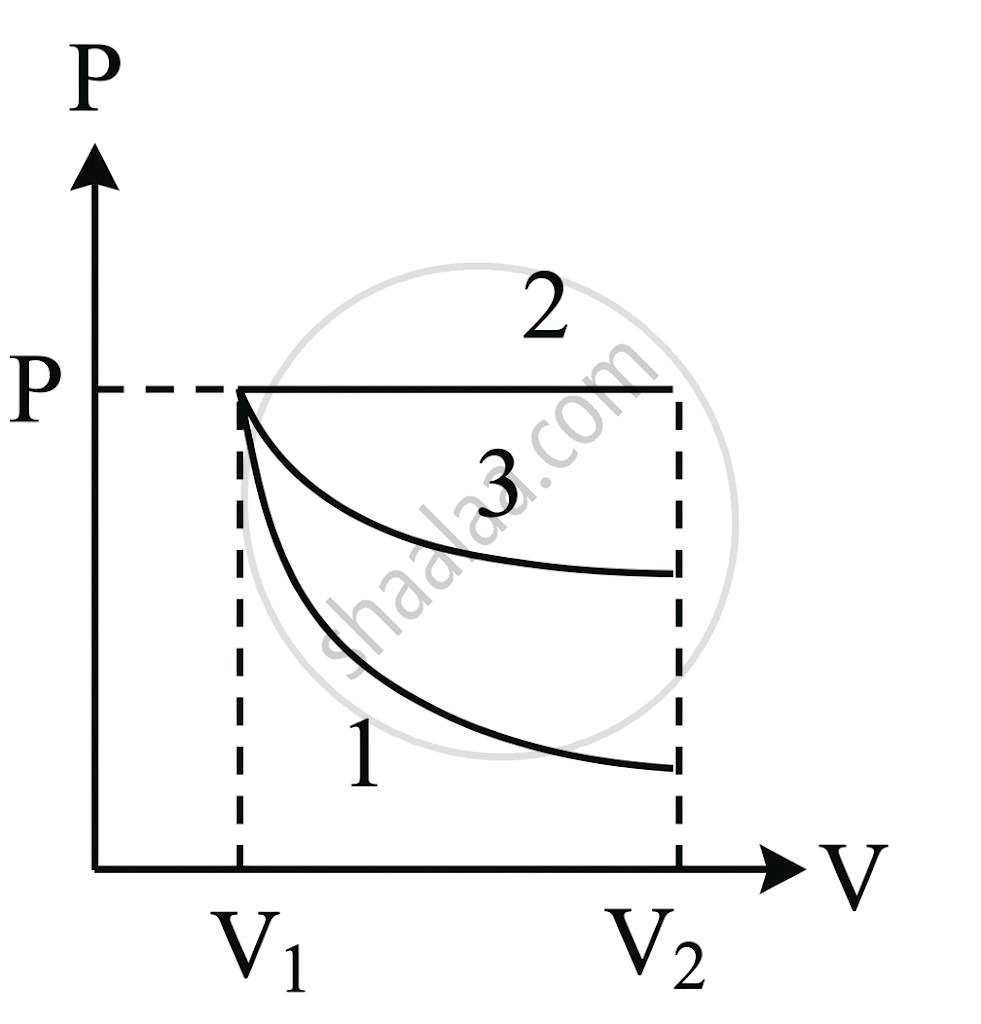
The work done is given by the area under the P-V curve. From figure, the work done for isobaric process is maximum while that for adiabatic is minimum.i.e., \[W_2>W_3>W_1\]
