Advertisements
Advertisements
Question
Show that the points A(1, 3), B(2, 6), C(5, 7) and D(4, 4) are the vertices of a rhombus.
= `a(1/t^2 + 1) = (a(t^2 + 1))/t^2`
Now `(1)/"SP" + (1)/"SQ" = (1)/(a(t^2 + 1)) + (1 xx t^2)/(a(t^2 + 1)`
= `((1 + t^2))/(a(t^2 + 1)`
`(1)/"SP" + (1)/"SQ" = (1)/a`.
Sum
Advertisements
Solution
To show that ABCD is a rhombus, it is sufficient to show that
(i) ABCD is a parallelogram i.e., AC and BD have the same mid point.
(ii) A pair of adjacent sides are equal.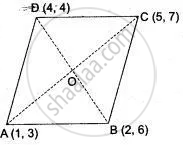
Now, ,midpoint of AC = `((1 + 5)/2, (3 + 7)/2)`
= (3, 5).
Midpoint of BD = `((4 + 2)/2, (4 + 6)/2)`
= (3, 5).
Thus, ABCD is a parallelogram.
Also AB2 = (2 - 1)2 + (6 - 3)2
= 1 + 9 = 10 units.
BC2 = (5 - 2)2 + (7 - 6)2
= 9 + 1 = 10 units.
Therefore AB2 = BC2 ⇒ AB = BC
Hence, ABCD is a rhombus.
shaalaa.com
Co-ordinates Expressed as (x,y)
Is there an error in this question or solution?
