Advertisements
Advertisements
Question
Show that the line segments joining the mid-points of opposite sides of a quadrilateral bisects each other.
Advertisements
Solution
Let ABCD is the quadrilateral and P, Q, R, S are mid points of the sides AB, BC, CD, DA respectively.
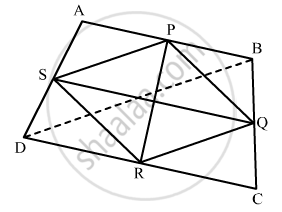
Join DB to form triangle ABD.
\[\frac{AS}{SD} = \frac{AP}{PB}\]
\[ \Rightarrow SP || DB \hspace{0.167em} \hspace{0.167em} and \hspace{0.167em} \hspace{0.167em} SP = \frac{1}{2} \hspace{0.167em} DB\]
In triangle BCD
\[\frac{CR}{RD} = \frac{CQ}{QB}\]
\[ \Rightarrow RQ || DB \hspace{0.167em} \hspace{0.167em} and \hspace{0.167em} \hspace{0.167em} RQ = \frac{1}{2} \hspace{0.167em} \hspace{0.167em} DB\]
In quadrilateral PQRS,
SP = RQ and SP || RQ
∴ PQRS is a parallelogram.
Diagonals of a parallelogram bisect each other.
∴ PR and QS bisect each other.
APPEARS IN
RELATED QUESTIONS
The two vectors `hatj+hatk " and " 3hati-hatj+4hatk` represent the two sides AB and AC, respectively of a ∆ABC. Find the length of the median through A
Let \[\vec{a,} \vec{b,} \vec{c,} \vec{d}\] be the position vectors of the four distinct points A, B, C, D. If \[\vec{b} - \vec{a} = \vec{c} - \vec{d}\], then show that ABCD is a parallelogram.
If \[\vec{a,} \vec{b}\] are the position vectors of A, B respectively, find the position vector of a point C in AB produced such that AC = 3 AB and that a point D in BA produced such that BD = 2BA.
Show that the four points A, B, C, D with position vectors \[\vec{a,} \vec{b,} \vec{c,} \vec{d}\] respectively such that \[3 \vec{a} - 2 \vec{b} + 5 \vec{c} - 6 \vec{d} = 0,\] are coplanar. Also, find the position vector of the point of intersection of the line segments AC and BD.
Prove by vector method that the internal bisectors of the angles of a triangle are concurrent.
If the position vector of a point (−4, −3) be \[\vec{a,}\] find \[\left| \vec{a} \right|\]
If the position vectors of the points A (3, 4), B (5, −6) and C (4, −1) are \[\vec{a,}\] \[\vec{b,}\] \[\vec{c}\] respectively, compute \[\vec{a} + 2 \vec{b} - 3 \vec{c}\].
If \[\vec{a}\] be the position vector whose tip is (5, −3), find the coordinates of a point B such that \[\overrightarrow{AB} =\] \[\vec{a}\], the coordinates of A being (4, −1).
The position vectors of points A, B and C are \[\lambda \hat{i} +\] 3 \[\hat{j}\],12\[\hat{i} + \mu\] \[\hat{j}\] and 11\[\hat{i} -\] 3 \[\hat{j}\] respectively. If C divides the line segment joining A and B in the ratio 3:1, find the values of \[\lambda\] and \[\mu\]
Find a unit vector in the direction of the resultant of the vectors
\[\hat{i} - \hat{j} + 3 \hat{k} , 2 \hat{i} + \hat{j} - 2 \hat{k} \text{ and }\hat{i} + 2 \hat{j} - 2 \hat{k} .\]
If \[\overrightarrow{PQ} = 3 \hat{i} + 2 \hat{j} - \hat{k}\] and the coordinates of P are (1, −1, 2), find the coordinates of Q.
If the vertices of a triangle are the points with position vectors \[a_1 \hat{i} + a_2 \hat{j} + a_3 \hat{k} , b_1 \hat{i} + b_2 \hat{j} + b_3 \hat{k} , c_1 \hat{i} + c_2 \hat{j} + c_3 \hat{k} ,\]
what are the vectors determined by its sides? Find the length of these vectors.
Find the position vector of a point R which divides the line segment joining points \[P \left( \hat{i} + 2 \hat{j} + \hat{k} \right) \text{ and Q }\left( - \hat{i} + \hat{j} + \hat{k} \right)\] internally 2:1.
Find the position vector of a point R which divides the line segment joining points:
\[P \left( \hat{i} + 2 \hat{j} + \hat{k}\right) \text { and } Q \left( - \hat{i} + \hat{j} + \hat{k} \right)\] externally
If the points with position vectors \[10 \hat{i} + 3 \hat{j} , 12 \hat{i} - 5 \hat{j}\text{ and a }\hat{i} + 11 \hat{j}\] are collinear, find the value of a.
If \[\vec{a,} \vec{b}\] are two non-collinear vectors prove that the points with position vectors \[\vec{a} + \vec{b,} \vec{a} - \vec{b}\text{ and }\vec{a} + \lambda \vec{b}\] are collinear for all real values of λ.
Show that the points whose position vectors are as given below are collinear:
\[2 \hat{i} + \hat{j} - \hat{k} , 3 \hat{i} - 2 \hat{j} + \hat{k} \text{ and }\hat{i} + 4 \hat{j} - 3 \hat{k}\]
Show that the four points having position vectors
\[6 \hat{i} - 7 \hat{j} , 16 \hat{i} - 19 \hat{j} - 4 \hat{k} , 3 \hat{j} - 6 \hat{k} , 2 \hat{i} - 5 \hat{j} + 10 \hat{k}\] are coplanar.
Show that the four points A, B, C and D with position vectors \[\vec{a}\], \[\vec{b}\], \[\vec{c}\], \[\vec{d}\] respectively are coplanar if and only if \[3 \vec{a} - 2 \vec{b} + \vec{c} - 2 \vec{d} = \vec{0} .\]
If D is the mid-point of side BC of a triangle ABC such that \[\overrightarrow{AB} + \overrightarrow{AC} = \lambda \overrightarrow{AD} ,\] write the value of λ.
Find the position vector of the point which divides the join of points with position vectors `vec"a" + 3vec"b" and vec"a"- vec"b"` internally in the ratio 1 : 3.
X and Y are two points with position vectors `3vec("a") + vec("b")` and `vec("a")-3vec("b")`respectively. Write the position vector of a point Z which divides the line segment XY in the ratio 2 : 1 externally.
Find the value of x such that the four-point with position vectors,
`"A"(3hat"i"+2hat"j"+hat"k"),"B" (4hat"i"+"x"hat"j"+5hat"k"),"c" (4hat"i"+2hat"j"-2hat"k")`and`"D"(6hat"i"+5hat"j"-hat"k")`are coplaner.
Find the position vector of a point R which divides the line joining the two points P and Q with position vectors `vec"OP" = 2vec"a" + vec"b"` and `vec"OQ" = vec"a" - 2vec"b"`, respectively, in the ratio 1:2 externally
The position vector of the point which divides the join of points with position vectors `vec"a" + vec"b"` and 2`vec"a" - vec"b"` in the ratio 1:2 is ______.
The position vector of the point which divides the join of points `2vec"a" - 3vec"b"` and `vec"a" + vec"b"` in the ratio 3:1 is ______.
Position vector of the mid-point of line segment AB is `3hati + 2hatj - 3hatk`. If position vector of the point A is `2hati + 3hatj - 4hatk`, then position vector of the point B is ______.
