Advertisements
Advertisements
Question
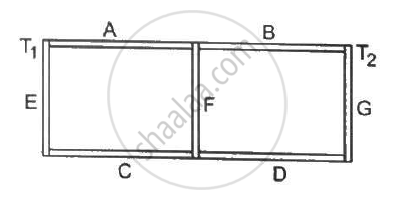
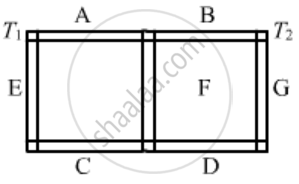
Seven rods A, B, C, D, E, F and G are joined as shown in the figure. All the rods have equal cross-sectional area A and length l. The thermal conductivities of the rods are KA = KC = K0, KB = KD = 2K0, KE = 3K0, KF = 4K0 and KG = 5K0. The rod E is kept at a constant temperature T1 and the rod G is kept at a constant temperature T2 (T2 > T1). (a) Show that the rod F has a uniform temperature T = (T1 + 2T2)/3. (b) Find the rate of heat flowing from the source which maintains the temperature T2.
Advertisements
Solution
Given:
KA = KC = K0
KB = KD = 2K0
KE = 3K0, KF = 4K0
K9= 5K0
Here, K denotes the thermal conductivity of the respective rods.
In steady state, temperature at the ends of rod F will be same.
Rate of flow of heat through rod A + rod C = Rate of flow of heat through rod B + rod D
`(K_A·A·(T-T_1))/ ( l ) + (K_c·A(T-T_1))/(l) + (K_B·A( T_2 - T ))/l`
2k0 ( T - T1 ) = 2 × 2 K0 ( T2 - T)
Temp of rod F = T = `(T_1 + 2T_2)/3`
(b) To find the rate of flow of heat from the source (rod G), which maintains a temperature T2 is given by
Rate of flow of heat, q = `(DeltaT)/("Thermal resistance")`
First, we will find the effective thermal resistance of the circuit.
From the diagram, we can see that it forms a balanced Wheatstone bridge.
Also, as the ends of rod F are maintained at the same temperature, no heat current flows through rod F.
Hence, for simplification, we can remove this branch.
From the diagram, we find that RA and RB are connected in series.
∴ RAB = RA + RB
RC and RD are also connected in series.
∴ RCD = RC + RD
Then, RAB and RCD are in parallel connection.
`R_A = l/(K_0A)`
`R_B = l/(2K_0A)`
`R_C = l /( K_0A)`
`R_D = l/(2K_0A)`
`R_{AB} = (3l)/(2k_0A)`
`R_{CD} = (3l)/(2K_0A)`
`R_"eff" = ((3l)/(2K_0A)xx(3l)/(2K_0A))/ (((3l)) /( 2K_0A) + (3l)/(2K_0A))`
`=(3l)/(4K_0A)`
`⇒ q = (DeltaT)/("R_eff")`
`= (T_1 - T_2)/((3l)/ (4K_0A))`
`⇒ (4K_0A(T_1 - T_2))/(3L)`
APPEARS IN
RELATED QUESTIONS
A solid object is placed in water contained in an adiabatic container for some time. The temperature of water falls during this period and there is no appreciable change in the shape of the object. The temperature of the solid object
A brick weighing 4.0 kg is dropped into a 1.0 m deep river from a height of 2.0 m. Assuming that 80% of the gravitational potential energy is finally converted into thermal energy, find this thermal energy is calorie.
A block of mass 100 g slides on a rough horizontal surface. If the speed of the block decreases from 10 m s−1 to 5 m s−1, find the thermal energy developed in the process.
A hot liquid is kept in a big room. The logarithm of the numerical value of the temperature difference between the liquid and the room is plotted against time. The plot will be very nearly
A uniform slab of dimension 10 cm × 10 cm × 1 cm is kept between two heat reservoirs at temperatures 10°C and 90°C. The larger surface areas touch the reservoirs. The thermal conductivity of the material is 0.80 W m−1 °C−1. Find the amount of heat flowing through the slab per minute.
Water is boiled in a container having a bottom of surface area 25 cm2, thickness 1.0 mm and thermal conductivity 50 W m−1°C−1. 100 g of water is converted into steam per minute in the steady state after the boiling starts. Assuming that no heat is lost to the atmosphere, calculate the temperature of the lower surface of the bottom. Latent heat of vaporisation of water = 2.26 × 10⁶ J kg−1.
A pitcher with 1-mm thick porous walls contains 10 kg of water. Water comes to its outer surface and evaporates at the rate of 0.1 g s−1. The surface area of the pitcher (one side) = 200 cm2. The room temperature = 42°C, latent heat of vaporization = 2.27 × 10⁶ J kg−1, and the thermal conductivity of the porous walls = 0.80 J s−1 m−1°C−1. Calculate the temperature of water in the pitcher when it attains a constant value.
The ends of a metre stick are maintained at 100°C and 0°C. One end of a rod is maintained at 25°C. Where should its other end be touched on the metre stick so that there is no heat current in the rod in steady state?
A metal rod of cross sectional area 1.0 cm2 is being heated at one end. At one time, the temperatures gradient is 5.0°C cm−1 at cross section A and is 2.5°C cm−1 at cross section B. Calculate the rate at which the temperature is increasing in the part AB of the rod. The heat capacity of the part AB = 0.40 J°C−1, thermal conductivity of the material of the rod = 200 W m−1°C−1. Neglect any loss of heat to the atmosphere
A hole of radius r1 is made centrally in a uniform circular disc of thickness d and radius r2. The inner surface (a cylinder a length d and radius r1) is maintained at a temperature θ1 and the outer surface (a cylinder of length d and radius r2) is maintained at a temperature θ2 (θ1 > θ2). The thermal conductivity of the material of the disc is K. Calculate the heat flowing per unit time through the disc.
A hollow tube has a length l, inner radius R1 and outer radius R2. The material has a thermal conductivity K. Find the heat flowing through the walls of the tube if (a) the flat ends are maintained at temperature T1 and T2 (T2 > T1) (b) the inside of the tube is maintained at temperature T1 and the outside is maintained at T2.
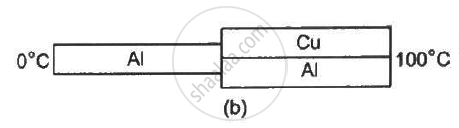
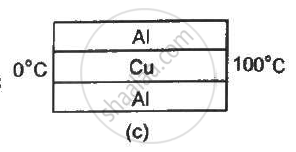
The three rods shown in figure have identical geometrical dimensions. Heat flows from the hot end at a rate of 40 W in the arrangement (a). Find the rates of heat flow when the rods are joined as in arrangement (b) and in (c). Thermal condcutivities of aluminium and copper are 200 W m−1°C−1 and 400 W m−1°C−1 respectively.

A rod of negligible heat capacity has length 20 cm, area of cross section 1.0 cm2 and thermal conductivity 200 W m−1°C−1. The temperature of one end is maintained at 0°C and that of the other end is slowly and linearly varied from 0°C to 60°C in 10 minutes. Assuming no loss of heat through the sides, find the total heat transmitted through the rod in these 10 minutes.
Two bodies of masses m1 and m2 and specific heat capacities s1 and s2 are connected by a rod of length l, cross-sectional area A, thermal conductivity K and negligible heat capacity. The whole system is thermally insulated. At time t = 0, the temperature of the first body is T1 and the temperature of the second body is T2 (T2 > T1). Find the temperature difference between the two bodies at time t.
An amount n (in moles) of a monatomic gas at an initial temperature T0 is enclosed in a cylindrical vessel fitted with a light piston. The surrounding air has a temperature Ts (> T0) and the atmospheric pressure is Pα. Heat may be conducted between the surrounding and the gas through the bottom of the cylinder. The bottom has a surface area A, thickness x and thermal conductivity K. Assuming all changes to be slow, find the distance moved by the piston in time t.
