Advertisements
Advertisements
Question
Select the correct answer from the choice in the bracket.
The positively charged particle of an atom.
Options
electron
proton
neturon
Advertisements
Solution
proton
APPEARS IN
RELATED QUESTIONS
What are the advantages of chromatography?
Give two applications of chromatography.
Name: a Non-metal Which is a Good Conductor of Electricity.
Give two examples of Metals.
Find the atomicity of the Following molecule:
Dinitrogen Oxide
Fill in the blank
The most abundant element in the earth’s crust is _______.
Indicate whether the following statement is true or false:
Metals reflect light and are good conductors of electricity
Tick (√) the correct alternative from the choice given for the following statement.
Sugar is a compound which consists of the elements
Tick (√) the correct alternative from the choice given for the following statement.
Sulphur and carbon are
Tick (√) the correct alternative from the choice given for the following statement.
The compound used as common salt is
Tick (√) the correct alternative from the choice given for the following statement
A metal which is brittle
Tick (√) the correct alternative from the choice given for the following statement
A gaseous non-metal.
The important physical properties of substances are colour, odour, nature, density & solubility in water.
Name – a gas with a pungent, choking odour which is lighter than air
Elements are classified into – Metals – Non-metals – Metalloids – Noble gases. State which of A, B, C, D is a –
1. Metallic element
2. Non-metallic element
3. Metalloid
4. Noble gas.
A: Is non-malleable, non-ductile & a poor conductor of electricity ___________
B: Has lustre, is malleable and ductile & a good conductor of heat ___________
C: Is unreactive and inert and present in traces in the air _________
D: Shows properties of both metals and non-metals ___________
State what are radicals. Give the names of the radicals –
(a) NO3
(b) OH
(c) SO4
(d) CO3
Explain the difference between Atoms and molecules.
Elements are broadly classified into metals and non-metals. State six general differences in the physical properties of metals and non-metals. State two metals and two non-metals which contradict with the general physical properties – giving reasons. State one difference in property between metalloids and noble gases.
State five different characteristics of compounds.
Differentiate metals and non-metals.
Higher Order Thinking Skills.
In the diagram given below, the circle, square and triangle represent the atoms of different elements.
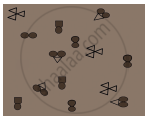
Identify all combinations that represent
- molecule of a compound
- molecule of an element consisting of two atoms
- molecule of an element consisting of three atoms
