Advertisements
Advertisements
Question
Write appropriate question words in the blank spaces in the following dialogue.
Neha: ______ did you get this book?
Sheela: Yesterday morning.
Neha: ______ is your sister crying?
Sheela : Because she has lost her doll.
Neha: ______ room is this, yours or hers?
Sheela: It’s ours
Neha: ______ do you go to school?
Sheela: We walk to the school. It is nearby.
Advertisements
Solution
Neha: When did you get this book?
Sheela: Yesterday morning.
Neha: Why is your sister crying?
Sheela : Because she has lost her doll.
Neha: Whose room is this, yours or hers?
Sheela: It’s ours
Neha: How do you go to school?
Sheela: We walk to the school. It is nearby.
RELATED QUESTIONS
Discuss these question in class with your teacher and then write down your answer
in two or three paragraphs .
Kezia decides that there are “different kinds of fathers”. What kind of father was Mr
Macdonald, and how was he different from Kezia’s father?
Thinking about the Text
On the following map mark out the route, which the author thought of but did not take, to Delhi.
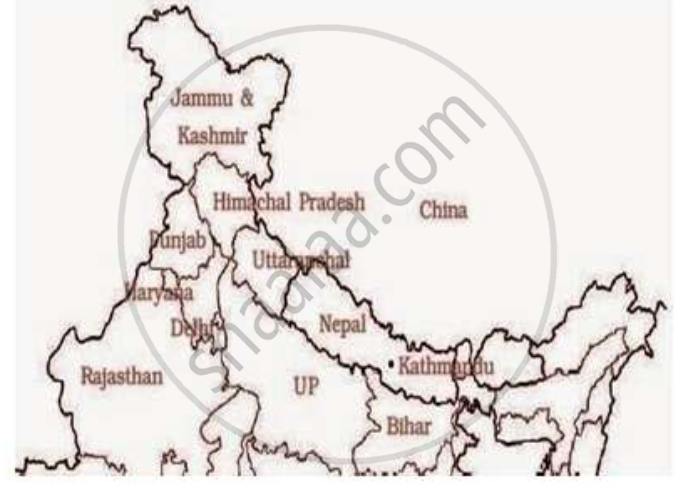
The poem you have just read is originally in the Tamil. Do you know any such poems in your language?
1. What kind of place is Innisfree? Think about:
- the three things the poet wants to do when he goes back there (stanza I);
- what he hears and sees there and its effect on him (stanza II);
- what he hears in his “heart’s core” even when he is far away from Innisfree (stanza III).
2. By now you may have concluded that Innisfree is a simple, natural place, full of beauty and peace. How does the poet contrast it with where he now stands? (Read stanza III).
3. Do you think Innisfree is only a place, or a state of mind? Does the poet actually miss the place of his boyhood days?
On the basis of your understanding of the poem, answer the following questions
by ticking the correct choice.
The setting of the poem is ___________.
What does he plant who plants a tree?
He plants, in sap and leaf and wood,
In love of home and loyalty
And far-cast thought of civic good____
His blessing on the neighbourhood,
Who in the hollow of his hand
Holds all the growth of all our land____
A nation's growth from sea to sea
Stirs in his heart who plants a tree.
Read the lines given above and answer the question that follow:
How is the man holding the blessing on his neighborhood in his hand?
The black man's face bespoke revenge
As the fire passed from his sight.
For all he saw in his stick of wood
Was a chance to spite the white.
The last man of this forlorn group
Did nought except for gain.
Giving only to those who gave
Was how he played the game.
Their logs held tight in death's still hands
Was proof of human sin.
They didn't die from the cold without
They died from the cold within.
Read the lines given above and answer the question that follow.
Explain with reference to context
To us the ashes of our ancestors are sacred and their resting place is hallowed ground. You wander far from the graves of your ancestors and seemingly without regret. Your religion was written upon tablets of stone by the iron finger of your God so that you could not forget. The Red Man could never comprehend or remember it. Our religion is the traditions of our ancestors — the dreams of our old men, given them in solemn hours of the night by the Great Spirit; and the visions of our sachems, and is written in the hearts of our people.
Day and night cannot dwell together. The Red Man has ever fled the approach of the White Man, as the morning mist flees before the morning sun. However, your proposition seems fair and I think that my people will accept it and will retire to the reservation you offer them. Then we will dwell apart in peace, for the words of the Great White Chief seem to be the words of nature speaking to my people out of dense darkness.
Read the extract given below and answer the question that follow.
Where was the religion of the White people written?
Margot stood apart from these children who could never remember a time when there wasn’t rain and rain and rain. They were all nine years old, and if there had been a day, seven years ago, when the sun came out for an hour and showed its face to the stunned world, they could not recall. Sometimes, at night, she heard them stir, in remembrance, and she knew they were dreaming and remembering an old or a yellow crayon or a coin large enough to buy the world with. She knew they thought they remembered a warmness, like a blushing in the face, in the body, in the arms and legs and trembling hands. But then they always awoke to the tatting drum, the endless shaking down of clear bead necklaces upon the roof, the walk, the gardens, the forests, and their dreams were gone. All day yesterday they had read in class about the sun. About how like a lemon it was, and how hot. And they had written small stories or essays or poems about it:
I think the snn is a flower,
That blooms for just one hour.
Read the extract given below and answer the question that follow.
What memory disturbed the children at night sometimes?
Mr Gessler in his last wasn’t in good health. Give three examples to prove this.
What, according to the python, were the advantages of a long nose (trunk)?
- What happens if Raga Deepak is sung properly?
- Why did Tansen’s enemies want him to sing the Raga?
How did Vijay Singh feel when he was told to go to the Haunted Deserts?
How did the villagers react after tasting the water of the magic waterfall?
Multiple Choice Question:
When does the kite look bright?
Multiple Choice Question:
What does the word ‘soars’ in the above extract mean?
The words given against the sentences below can be used both as nouns and verbs. Use them appropriately to fill in the blanks.
(i) The police are _______________________ the area to catch the burglars. (comb)
(ii) An ordinary plastic ______________________________ costs five rupees.
Read the extract given below and answer the questions that follow:
| GRATIANO: O learned judge! – Mark, Jew: a learned judge! SHYLOCK: I take this offer, then; pay the bond thrice, And let the Christian go. |
- Why does Shylock suddenly decide to accept this offer? [2]
- Who has made this offer? Who stops Shylock from accepting this offer? [2]
- Shylock decides to leave the court without even receiving the principal amount. What other crime is he accused of? What further punishment does he face for this crime? [3]
- Later in this scene, how does the Duke show that he is merciful? What does Shylock say in response to the Duke’s act of mercy? [3]
Where was Caesar put to death?
Which of the following BEST captures the central idea of the short story, The Medicine Bag?
