Advertisements
Advertisements
Question
Prove by vector method that the sum of the squares of the diagonals of a parallelogram is equal to the sum of the squares of its sides.
Advertisements
Solution
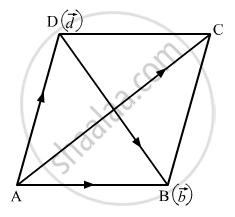
Let ABCD be a parallelogram such that AC and BD are its two diagonals. Taking A as the origin, let the position vectors of B and D be \[\vec{b}\] and \[\vec{d}\] respectively.
Then, \[\vec{AB} = \vec{b}\] and \[\vec{AD} = \vec{d}\]
Using triangle law of vector addition, we have
\[\vec{AD} + \vec{DB} = \vec{AB} \]
\[ \Rightarrow \vec{DB} = \vec{b} - \vec{d}\]
In ∆ABC,
\[\vec{AC} = \vec{AB} + \vec{BC} = \vec{AB} + \vec{AD} = \vec{b} + \vec{d}\]
Now,
\[\left| \vec{AB} \right|^2 + \left| \vec{BC} \right|^2 + \left| \vec{CD} \right|^2 + \left| \vec{DA} \right|^2 \]
\[ = \left| \vec{AB} \right|^2 + \left| \vec{AD} \right|^2 + \left| - \vec{AB} \right|^2 + \left| - \vec{AD} \right|^2 \]
\[ = 2 \left| \vec{AB} \right|^2 + 2 \left| \vec{AD} \right|^2 \]
\[ = 2 \left| \vec{b} \right|^2 + 2 \left| \vec{d} \right|^2 . . . . . \left( 1 \right)\]
Also,
\[\left| \vec{DB} \right|^2 + \left| \vec{AC} \right|^2 \]
\[ = \left| \vec{b} - \vec{d} \right|^2 + \left| \vec{b} + \vec{d} \right|^2 \]
\[ = \left( \vec{b} - \vec{d} \right) . \left( \vec{b} - \vec{d} \right) + \left( \vec{b} + \vec{d} \right) . \left( \vec{b} + \vec{d} \right)\]
\[ = \left| \vec{b} \right|^2 - 2 \vec{b} . \vec{d} + \left| \vec{d} \right|^2 + \left| \vec{b} \right|^2 + 2 \vec{b} . \vec{d} + \left| \vec{d} \right|^2 \]
\[ = 2 \left| \vec{b} \right|^2 + 2 \left| \vec{d} \right|^2 . . . . . \left( 2 \right)\]
From (1) and (2), we have
APPEARS IN
RELATED QUESTIONS
Find the position vector of a point R which divides the line joining two points P and Q whose position vectors are `P(2veca + vecb)` and `Q(veca - 3vecb)` externally in the ratio 1: 2. Also, show that P is the mid point of the line segment RQ.
Prove that: If the diagonals of a quadrilateral bisect each other at right angles, then it is a rhombus.
(Pythagoras's Theorem) Prove by vector method that in a right angled triangle, the square of the hypotenuse is equal to the sum of the squares of the other two sides.
If AD is the median of ∆ABC, using vectors, prove that \[{AB}^2 + {AC}^2 = 2\left( {AD}^2 + {CD}^2 \right)\]
Find the position vector of point R which divides the line joining the points P and Q whose position vectors are `2hat"i" - hat"j" + 3hat"k"` and `- 5hat"i" + 2hat"j" - 5hat"k"` in the ratio 3 : 2 is externally.
Find the position vector of midpoint M joining the points L(7, –6, 12) and N(5, 4, –2).
Prove that the line segments joining the midpoints of the adjacent sides of a quadrilateral form a parallelogram.
Prove that the median of a trapezium is parallel to the parallel sides of the trapezium and its length is half of the sum of the lengths of the parallel sides.
If the centroid of a tetrahedron OABC is (1, 2, - 1) where A(a, 2, 3), B(1, b, 2), C(2, 1, c), find the distance of P(a, b, c) from origin.
Find the centroid of tetrahedron with vertices K(5, −7, 0), L(1, 5, 3), M(4, −6, 3), N(6, −4, 2)
If D, E, F are the midpoints of the sides BC, CA, AB of a triangle ABC, prove that `bar"AD" + bar"BE" + bar"CF" = bar0`.
Find the volume of a parallelopiped whose coterimus edges are represented by the vectors `hat"i" + hat"k", hat"i" + hat"k", hat"i" + hat"j"`. Also find volume of tetrahedron having these coterminus edges.
If `bara, barb` and `barc` are position vectors of the points A, B, C respectively and `5bara - 3barb - 2barc = bar0`, then find the ratio in which the point C divides the line segement BA.
Find the position vector of point R which divides the line joining the points P and Q whose position vectors are `2hat"i" - hat"j" + 3hat"k"` and `-5hat"i" + 2hat"j" - 5hat"k"` in the ratio 3:2
(i) internally
(ii) externally
If A(5, 1, p), B(1, q, p) and C(1, −2, 3) are vertices of triangle and `"G"("r", -4/3, 1/3)` is its centroid then find the values of p, q and r
Prove that altitudes of a triangle are concurrent
Prove that the angle bisectors of a triangle are concurrent
Using vector method, find the incenter of the triangle whose vertices are A(0, 3, 0), B(0, 0, 4) and C(0, 3, 4)
If the plane 2x + 3y + 5z = 1 intersects the co-ordinate axes at the points A, B, C, then the centroid of Δ ABC is ______.
Let G be the centroid of a Δ ABC and O be any other point in that plane, then OA + OB + OC + CG = ?
In a quadrilateral ABCD, M and N are the mid-points of the sides AB and CD respectively. If AD + BC = tMN, then t = ____________.
P is the point of intersection of the diagonals of the parallelogram ABCD. If O is any point, then `overline"OA" + overline"OB" + overline"OC" + overline"OD"` = ______
If P(2, 2), Q(- 2, 4) and R(3, 4) are the vertices of Δ PQR then the equation of the median through vertex R is ______.
The image of the point (1, 6, 3) in the line `x/1 = (y - 1)/2 = (z - 2)/3` is ______
If the orthocentre and circumcentre of a triangle are (-3, 5, 1) and (6, 2, -2) respectively, then its centroid is ______
If M and N are the midpoints of the sides BC and CD respectively of a parallelogram ABCD, then `overline(AM) + overline(AN)` = ______
If `3bar"a" + 5bar"b" = 8bar"c"`, then A divides BC in tbe ratio ______.
If A, B, C are the vertices of a triangle whose position vectors are `overline("a"),overline("b"),overline("c")` and G is the centroid of the `triangle ABC,` then `overline("GA")+overline("GB")+overline("GC")` is ______.
The co-ordinates of the points which divides line segment joining the point A(2, –6, 8) and B(–1, 3,–4) internally in the ratio 1: 3' are ______.
In ΔABC, P is the midpoint of BC, Q divides CA internally in the ratio 2:1 and R divides AB externally in the ratio 1:2, then ______.
ΔABC has vertices at A = (2, 3, 5), B = (–1, 3, 2) and C = (λ, 5, µ). If the median through A is equally inclined to the axes, then the values of λ and µ respectively are ______.
If `overlinea, overlineb, overlinec` are the position vectors of the points A, B, C respectively and `5overlinea + 3overlineb - 8overlinec = overline0` then find the ratio in which the point C divides the line segment AB.
The position vectors of three consecutive vertices of a parallelogram ABCD are `A(4hati + 2hatj - 6hatk), B(5hati - 3hatj + hatk)`, and `C(12hati + 4hatj + 5hatk)`. The position vector of D is given by ______.
Using vector method, prove that the perpendicular bisectors of sides of a triangle are concurrent.
Find the ratio in which the point C divides segment AB, if `5bara + 4barb - 9barc = bar0`
If `bara, barb, barc` are the position vectors of the points A, B, C respectively and `5 bar a - 3 bar b - 2 bar c = bar 0`, then find the ratio in which the point C divides the line segment BA.
The position vector of points A and B are `6 bara + 2 barb and bara - 3 barb`. If the point C divides AB in the ratio 3 : 2 then show that the position vector of C is `3 bara - barb`.
