Advertisements
Advertisements
Question
Prove that two different circles cannot intersect each other at more than two points.
Advertisements
Solution
Suppose two circles intersect in three points A,B,C,
Then A,B,C are non-collinear. So, a unique circle passes through these three points. This is contradiction to the face that two given circles are passing through A,B,C. Hence, two circles cannot intersect each other at more than two points.
APPEARS IN
RELATED QUESTIONS
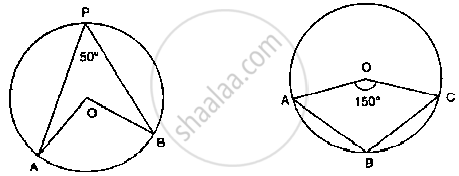
In the below fig. O is the centre of the circle. If ∠APB = 50°, find ∠AOB and ∠OAB.
The figure given below shows a circle with center O in which diameter AB bisects the chord CD at point E. If CE = ED = 8 cm and EB = 4 cm,
find the radius of the circle.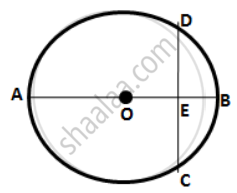
Find the length of the chord AC where AB and CD are the two diameters perpendicular to each other of a circle with radius `4sqrt(2)` cm and also find ∠OAC and ∠OCA
If angle between two tangents drawn from a point P to a circle of radius a and centre O is 60°, then OP = `asqrt(3)`
If A, B, C, D are four points such that ∠BAC = 30° and ∠BDC = 60°, then D is the centre of the circle through A, B and C.
A quadrilateral ABCD is inscribed in a circle such that AB is a diameter and ∠ADC = 130º. Find ∠BAC.
In the following figure, O is the centre of the circle. Name a chord, which is not the diameter of the circle.

From the figure, identify a chord.

If radius of a circle is 5 cm, then find the length of longest chord of a circle.
What is the name for the perimeter of a circle?
