Advertisements
Advertisements
Question
Prove that the bisectors of the angles of a parallelogram form a rectangle.
Advertisements
Solution
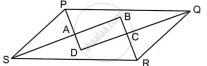
Given: Parallelogram PQRS.
To Prove: The quadrilateral formed by the bisectors of the angles of parallelogram PQRS is a rectangle.
Proof:
1. Let the bisectors of the angles at vertices P, Q, R and S intersect in such a way that they form a quadrilateral inside the parallelogram. Name the intersection points of the adjacent bisectors as A, B, C and D respectively (as shown in the figure).
2. Since PQRS is a parallelogram, opposite angles are equal: ∠P = ∠R and ∠Q = ∠S
3. The sum of angles at adjacent vertices of a parallelogram is 180°: ∠P + ∠Q = 180°
4. The bisector of an angle divides it into two equal parts. Therefore, the angle between two adjacent bisectors (such as those at P and Q) inside the quadrilateral is half the sum of adjacent angles of the parallelogram:
∠Between adjacent bisectors = `(∠P)/2 + (∠Q)/2`
= `(∠P + ∠Q)/2`
= `180^circ/2`
= 90°
5. Thus, each interior angle of the quadrilateral formed by the angle bisectors is 90°, making it a rectangle.
The quadrilateral formed by bisectors of the angles of a parallelogram is a rectangle, because all its interior angles are right angles.
