Advertisements
Advertisements
Question
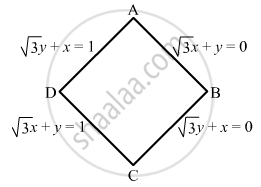
Prove that the lines \[\sqrt{3}x + y = 0, \sqrt{3}y + x = 0, \sqrt{3}x + y = 1 \text { and } \sqrt{3}y + x = 1\] form a rhombus.
Advertisements
Solution
The given lines are as follows:
\[\sqrt{3}x + y = 0\] ... (1)
\[\sqrt{3}y + x = 0\] ... (2)
\[\sqrt{3}x + y = 1\] ... (3)
\[\sqrt{3}y + x = 1\] ... (4)
In quadrilateral ABCD, let equations (1), (2), (3) and (4) represent the sides AB, BC, CD and DA,respectively.
Lines (1) and (3) are parallel and lines (2) and (4) are parallel.
Solving (1) and (2):
x = 0, y = 0.
Thus, AB and BC intersect at B (0, 0).
Solving (1) and (4):
x = \[- \frac{1}{2}\], y = \[\frac{\sqrt{3}}{2}\]
Thus, AB and DA intersect at \[A \left( - \frac{1}{2}, \frac{\sqrt{3}}{2} \right)\].
Solving (3) and (2):
x = \[\frac{\sqrt{3}}{2}\] , y = \[- \frac{1}{2}\]
Thus, BC and CD intersect at \[C \left( \frac{\sqrt{3}}{2}, - \frac{1}{2} \right)\].
Solving (3) and (4):
x = \[\frac{\sqrt{3} - 1}{2}\] , y = \[\frac{\sqrt{3} - 1}{2}\]
Thus, DA and CD intersect at
\[D \left( \frac{\sqrt{3} - 1}{2}, \frac{\sqrt{3} - 1}{\sqrt{3}} \right)\].
Let us find the lengths of sides AB, BC and CD and DA.
\[AB = \sqrt{\left( 0 - \frac{1}{2} \right)^2 + \left( 0 - \frac{\sqrt{3}}{2} \right)^2} = 1\]
\[BC = \sqrt{\left( \frac{\sqrt{3}}{2} - 0 \right)^2 + \left( - \frac{1}{2} - 0 \right)^2} = 1\]
\[CD = \sqrt{\left( \frac{\sqrt{3} - 1}{2} - \frac{\sqrt{3}}{2} \right)^2 + \left( \frac{\sqrt{3} - 1}{2} + \frac{1}{2} \right)^2} = 1\]
\[DA = \sqrt{\left( \frac{\sqrt{3} - 1}{2} + \frac{1}{2} \right)^2 + \left( \frac{\sqrt{3} - 1}{2} - \frac{\sqrt{3}}{2} \right)^2} = 1\]
Hence, the given lines form a rhombus.
APPEARS IN
RELATED QUESTIONS
Find the equation of the line that satisfies the given condition:
Passing through the point (−4, 3) with slope `1/2`.
Find the equation of the line which satisfy the given condition:
Passing though (0, 0) with slope m.
Find the equation of the line which satisfy the given condition:
Intersects the x-axis at a distance of 3 units to the left of origin with slope –2.
Find the equation of the line which satisfy the given condition:
Passing through the points (–1, 1) and (2, –4).
Find the equation of the line which satisfy the given condition:
The vertices of ΔPQR are P (2, 1), Q (–2, 3) and R (4, 5). Find equation of the median through the vertex R.
The vertices of ΔPQR are P (2, 1), Q (–2, 3) and R (4, 5). Find equation of the median through the vertex R.
Find the equation of the line passing through (–3, 5) and perpendicular to the line through the points (2, 5) and (–3, 6).
A line perpendicular to the line segment joining the points (1, 0) and (2, 3) divides it in the ratio 1:n. Find the equation of the line.
Find the equation of a line that cuts off equal intercepts on the coordinate axes and passes through the point (2, 3).
Find equation of the line passing through the point (2, 2) and cutting off intercepts on the axes whose sum is 9.
Find equation of the line through the point (0, 2) making an angle `(2pi)/3` with the positive x-axis. Also, find the equation of line parallel to it and crossing the y-axis at a distance of 2 units below the origin.
The perpendicular from the origin to a line meets it at the point (– 2, 9), find the equation of the line.
The length L (in centimetre) of a copper rod is a linear function of its Celsius temperature C. In an experiment, if L = 124.942 when C = 20 and L = 125.134 when C = 110, express L in terms of C
The owner of a milk store finds that, he can sell 980 litres of milk each week at Rs 14/litre and 1220 litres of milk each week at Rs 16/litre. Assuming a linear relationship between selling price and demand, how many litres could he sell weekly at Rs 17/litre?
P (a, b) is the mid-point of a line segment between axes. Show that equation of the line is `x/a + y/b = 2`
Point R (h, k) divides a line segment between the axes in the ratio 1:2. Find equation of the line.
Find the area of the triangle formed by the lines y – x = 0, x + y = 0 and x – k = 0.
Find the image of the point (3, 8) with respect to the line x + 3y = 7 assuming the line to be a plane mirror.
If the lines y = 3x + 1 and 2y = x + 3 are equally inclined to the line y = mx + 4, find the value of m.
Classify the following pair of line as coincident, parallel or intersecting:
x − y = 0 and 3x − 3y + 5 = 0]
Classify the following pair of line as coincident, parallel or intersecting:
3x + 2y − 4 = 0 and 6x + 4y − 8 = 0.
Find the equation to the straight line parallel to 3x − 4y + 6 = 0 and passing through the middle point of the join of points (2, 3) and (4, −1).
Find the equation of the line mid-way between the parallel lines 9x + 6y − 7 = 0 and 3x + 2y + 6 = 0.
Show that the diagonals of the parallelogram whose sides are lx + my + n = 0, lx + my + n' = 0, mx + ly + n = 0 and mx + ly + n' = 0 include an angle π/2.
Show that the point (3, −5) lies between the parallel lines 2x + 3y − 7 = 0 and 2x + 3y + 12 = 0 and find the equation of lines through (3, −5) cutting the above lines at an angle of 45°.
Write an equation representing a pair of lines through the point (a, b) and parallel to the coordinate axes.
Three vertices of a parallelogram taken in order are (−1, −6), (2, −5) and (7, 2). The fourth vertex is
Let ABC be a triangle with A(–3, 1) and ∠ACB = θ, 0 < θ < `π/2`. If the equation of the median through B is 2x + y – 3 = 0 and the equation of angle bisector of C is 7x – 4y – 1 = 0, then tan θ is equal to ______.
