Advertisements
Advertisements
Question
Prove that the area in the first quadrant enclosed by the x-axis, the line x = \[\sqrt{3}y\] and the circle x2 + y2 = 4 is π/3.
Advertisements
Solution
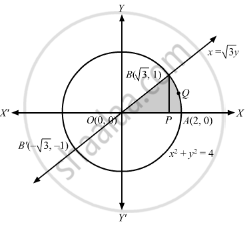
\[x^2 + y^2 = 4\] represents a circle with centre O(0,0) and radius 2 , cutting x axis at A(2,0) and A'(-2,0)
\[x = \sqrt{3} y\] represents a straight line passing through O(0,0)
Solving the two equations we get
\[x^2 + y^2 = 4\text{ and }x = \sqrt{3} y \]
\[ \Rightarrow \left( \sqrt{3}y \right)^2 + y^2 = 4\]
\[ \Rightarrow 4 y^2 = 4 \]
\[ \Rightarrow y = \pm 1\]
\[ \Rightarrow x = \pm \sqrt{3}\]
\[B\left( \sqrt{3} , 1 \right)\text{ and }B'\left( - \sqrt{3} , - 1 \right) \text{ are points of intersection of circle and straight line }\]
\[\text{ Shaded area }\left( OBQAO \right) = \text{ area }\left( OBPO \right) +\text{ area }\left( BAPB \right)\]
\[ = \frac{1}{\sqrt{3}} \int_0^\sqrt{3} x dx + \int_\sqrt{3}^2 \sqrt{4 - x^2} dx\]
\[ = \frac{1}{\sqrt{3}} \left[ \frac{x^2}{2} \right]_0^\sqrt{3} + \left[ \frac{1}{2}x\sqrt{4 - x^2} + \frac{4}{2} \sin^{- 1} \left( \frac{x}{2} \right) \right]_\sqrt{3}^2 \]
\[ = \frac{\sqrt{3}}{2} + 0 - \frac{\sqrt{3}}{2} + 2\left( \sin^{- 1} 1 - \sin^{- 1} \frac{\sqrt{3}}{2} \right)\]
\[ = \frac{\sqrt{3}}{2} - \frac{\sqrt{3}}{2} + 2\left( \frac{\pi}{2} - \frac{\pi}{3} \right)\]
\[ = \frac{\pi}{3}\text{ sq units }\]
\[\text{ Area bound by the circle and straight line above x axis }= \frac{\pi}{3}\text{ sq units }\]
