Advertisements
Advertisements
Question
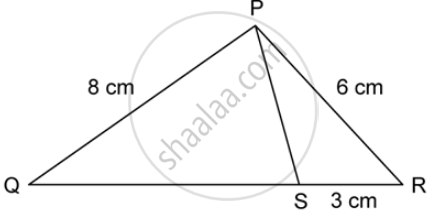
PQR is a triangle. S is a point on the side QR of ΔPQR such that ∠PSR = ∠QPR. Given QP = 8 cm, PR = 6 cm and SR = 3 cm.
- Prove ΔPQR ∼ ΔSPR.
- Find the lengths of QR and PS.
- Find `(Area of ΔPQR)/(Area of ΔSPR)`
Sum
Advertisements
Solution
(i)
In ∆PQR and ∆SPR,
∠PSR = ∠QPR ....given
∠PRQ = ∠PRS ....common angle
⇒ ∆PQR ∼ ∆SPR (AA Test)
(ii)
Find the lengths of QR and PS.
Since ∆PQR ∼ ∆SPR ....from (i)
`(PQ)/(SP) = (QR)/(PR) = (PR)/(SR)` ....(a)
⇒ `(QR)/(PR) = (PR)/(SR)` ....from (a)
`(QR)/6 = 6/3`
`QR = (6 xx 6)/3`
∴ QR = 12 cm
⇒ `(PQ)/(SP) = (PR)/(SR)` ....from (a)
`8/(SP) = 6/3`
`SP = (8 xx 3)/6`
∴ SP = 4 cm
(iii)
`(Area of ΔPQR)/(Area of ΔSPR) = (PQ^2)/(SP^2)`
`(Area of ΔPQR)/(Area of ΔSPR) = (8^2)/(4^2)`
`(Area of ΔPQR)/(Area of ΔSPR) = 64/16`
∴ `(Area of ΔPQR)/(Area of ΔSPR) = 4/1`
Hence,
- ∆PQR ∼ ∆SPR
- QR = 12 cm and SP = 4 cm
- (Area of ΔPQR) : (Area of ΔSPR) = 4 : 1
shaalaa.com
Is there an error in this question or solution?
