Advertisements
Advertisements
Question
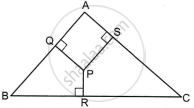
P is any point inside ΔABC and PQ, PR and PS are drawn perpendiculars to sides AB, BC and AC respectively. Prove that AQ2 + BR2 + CS2 = BQ2 + RC2 + AS2.
Theorem
Advertisements
Solution
Pythagoras theorem states that in a right angled triangle, the square on the hypotenuse is equal to the sum of the squares on the remaining two sides.
Applying Pythagoras theorem on all the right angle triangles, we get
In △AQP, AQ2 = PA2 – PQ2 ...(i)
In △BRP, BR2 = BP2 – PR2 ...(ii)
In △CSP, CS2 = CP2 – PS2 ...(iii)
Adding equations (i), (ii) and (iii), we get
AQ2 + BR2 + CS2 = PA2 + PB2 + PC2 – PQ2 – PR2 – PS2
AQ2 + BR2 + CS2 = (PA2 – PS)2 + (PB2 – PR2) + (PC2 – PQ2)
AQ2 + BR2 + CS2 = AS2 + BQ2 + RC2
Hence, proved.
shaalaa.com
Is there an error in this question or solution?
