Advertisements
Advertisements
Question
The centre of mass is defined as \[\vec{R} = \frac{1}{M} \sum_i m_i \vec{r_i}\]. Suppose we define "centre of charge" as \[\vec{R}_c = \frac{1}{Q} \sum_i q_i \vec{r_i}\] where qi represents the ith charge placed at \[\vec{r}_i\] and Q is the total charge of the system.
(a) Can the centre of charge of a two-charge system be outside the line segment joining the charges?
(b) If all the charges of a system are in X-Y plane, is it necessary that the centre of charge be in X-Y plane?
(c) If all the charges of a system lie in a cube, is it necessary that the centre of charge be in the cube?
Advertisements
Solution
(a) Yes
Consider a charge distributed in X-Y plane.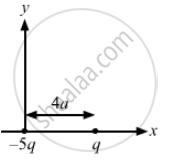
\[X_{cm} = \frac{- 6q \times 0 + q \times 5a}{- 6q + q} = - a\]
(b) Yes. Because the z-coordinates of all the charges are zero, the centre of charge lies in X-Y plane.
(c) No, it is not necessary that the centre of charge lies in the cube because charge can be either negative or positive.
