Advertisements
Advertisements
Question
On heating lead (II) nitrate gives a brown gas “A”. The gas “A” on cooling changes to colourless solid “B”. Solid “B” on heating with NO changes to a blue solid ‘C’. Identify ‘A’, ‘B’ and ‘C’ and also write reactions involved and draw the structures of ‘B’ and ‘C’.
Advertisements
Solution
The gas A is \[\ce{NO2}\]. The reactions are explained as under:
\[\ce{2Pb(NO3)2 ->[Heat][673 K] + 2PbO + \underset{(Brown colour)}{\underset{Nitrogen dioxide}{\underset{(A)}{4NO2}}} + O2}\]
\[\ce{2NO2 ->[Cooling] \underset{Solid (Colourless)}{\underset{(B)}{N2O4}}}\]
\[\ce{2NO + N2O4 ->[Heating] \underset{Dinitrogen trioxide}{\underset{(C)}{\underset{Blue solid}{2N2O3}}}}\]
Structure of B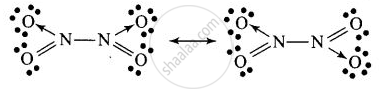
Structure of C
APPEARS IN
RELATED QUESTIONS
Write balanced chemical equations for action of potassium permanganate on: Hydrogen
Pb(NO3)2 on heating gives a brown gas which undergoes dimerisation on cooling? Identify the gas
Why does NO2 dimerise?
Why does the reactivity of nitrogen differ from phosphorus?
How is nitrogen prepared in the laboratory? Write the chemical equations of the reactions involved.
Give the resonating structure of N2O5.
Which of the following is a basic oxide?
(A) SiO2
(B) P4O10
(C) MgO
(D) Al2O3
Explain why Mn2+ ion is more stable than Mn3+? (Given : Mn→ Z=25)
Account for the following :
Bond angle in NH+4NH4+ is higher than NH3.
Which of the following statements is not correct for nitrogen?
Nitrogen is relatively inactive element because ____________.
The bonds present in N2O5 are ____________.
In which one of the following oxides of nitrogen, one nitrogen atom is not directly linked to oxygen?
Which of the following can be used as anesthesia?
A deep brown gas is formed by mixing two colourless gases which are:
The laughing gas is ____________.
On heating lead nitrate forms oxides of nitrogen and lead. The oxides formed are ______.
HCl is added to following oxides. Which one would give H2O2
Which oxide of nitrogen is obtained on heating ammonium nitrate at 250°C?
