Advertisements
Advertisements
Question
Observe the given diagram and answer the questions that follow:
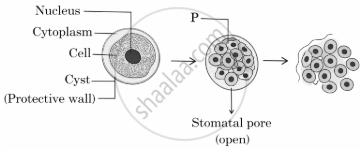
- Give the name and type of reproduction shown in the above diagram.
- Comment on the processes taking place in stage P.
- Name an organism which reproduces by the above mentioned method.
- Name the method that can be used to raise plants that have lost their capacity to produce seeds. List any two advantages of growing plants by such a method.
Very Long Answer
Advertisements
Solution
- Name: Multiple fission
Type: Asexual Reproduction. -
In stage P, the following processes occur:
- The parent cell develops a thick protective wall called a cyst to survive unfavorable conditions.
- The nucleus inside the cyst divides repeatedly by amitosis or mitosis to form many daughter nuclei.
- A small amount of cytoplasm then surrounds each daughter nucleus, resulting in the formation of many tiny daughter cells within the single parent cyst.
- An organism that reproduces by multiple fission is Plasmodium (the malarial parasite).
- The method used to raise plants that have lost their capacity to produce seeds is Vegetative Propagation.
Advantages of Vegetative Propagation:- Preservation of Traits: It ensures the production of plants that are genetically identical to the parent, maintaining desirable characteristics (genetic uniformity).
- Faster Growth: Plants raised this way generally bear flowers and fruits much earlier than those grown from seeds.
- Reliability: It allows for the certain propagation of plants that do not produce viable seeds, such as seedless bananas, jasmine, or roses.
shaalaa.com
Is there an error in this question or solution?
