Advertisements
Advertisements
Question
Observe the following conversion.
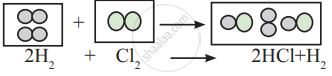
Is the above reaction is in accordance with the principle of stoichiometry?
Advertisements
Solution
- The reaction is in accordance with the principle of stoichiometry.
- In the reaction, chlorine is the limiting reagent, and it is completely consumed to form hydrogen chloride. Excess hydrogen remains unreacted at the end of the reaction.
- 2 mol hydrogen + 1 mol chlorine → 2 mol hydrogen chloride + 1 mol hydrogen
APPEARS IN
RELATED QUESTIONS
Define the term polarizability
Define the term Aqueous tension
Identify type of the intermolecular forces in the following compound.
CH2=CH2
Identify type of the intermolecular forces in the following compound.
CH2Cl2
Name the types of intermolecular forces present in Ar.
Name the types of intermolecular forces present in Cl2.
Name the types of intermolecular forces present in CCl4.
Name the types of intermolecular forces present in HNO3.
The force of attraction between any two nonpolar molecules is ____________.
Based on intermolecular forces, which of the following is a fibre?
In which of the following compounds intramolecular hydrogen bonding is present?
Which of the following molecules have London forces as predominant intermolecular force of attraction?
The compound incapable of hydrogen bonding with water is ______.
In ____________, hydrogen bonding is stronger than corresponding alcohols.
What type of inter molecular force is present between magnesium chloride and water?
In which of the following compound intra molecular hydrogen bonding is present?
Identify the type of intermolecular force present between benzene and ammonia.
Which among the following compounds has highest melting point?
Which of the following alkane has strong London dispersion forces?
