Advertisements
Advertisements
Question
O is the point of intersection of the diagonals AC and BD of a trapezium ABCD with AB || DC. Through O, a line segment PQ is drawn parallel to AB meeting AD in P and BC in Q. Prove that PO = QO.
Advertisements
Solution
Given ABCD is a trapezium.
Diagonals AC and BD are intersect at O.
PQ || AB || DC
To prove: PO = QO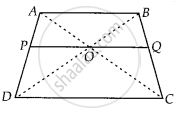
Proof: In ∆ABD and ∆POD,
PO || AB ...[∵ PQ || AB]
∠D = ∠D ...[Common angle]
∠ABD = ∠POD ...[Corresponding angles]
∴ ∆ABD ~ ∆POD ...[By AAA similarity criterion]
Then, `("OP")/("AB") = ("PD")/("AD")` ...(i)
In ∆ABC and ∆OQC,
OQ || AB ...[∵ OQ || AB]
∠C = ∠C ...[Common angle]
∠BAC = ∠QOC ...[Corresponding angles]
∴ ∆ABC ~ ∆OQC ...[By AAA similarity criterion]
Then, `("OQ")/("AB") = ("QC")/("BC")` ...(ii)
Now, In ∆ADC,
OP || DC
∴ `("AP")/("PD") = ("OA")/("OC")` [By basic proportionality theorem] ...(iii)
In ∆ABC,
OQ || AB
∴ `("BQ")/("QC") = ("OA")/("OC")` [By basic proportionality theorem] ...(iv)
From equations (iii) and (iv), we get
`("AP")/("PD") = ("BQ")/("QC")`
Adding 1 on both sides, we get
`("AP")/("PD") + 1 = ("BQ")/("QC") + 1`
⇒ `("AP" + "PD")/("PD") = ("BQ" + "QC")/("QC")`
⇒ `("AD")/("PD") = ("BC")/("QC")`
⇒ `("PD")/("AD") = ("QC")/("BC")`
⇒ `("OP")/("AB") = ("OQ")/("BC")` ...[From equations (i) and (ii)]
⇒ `("OP")/("AB") = ("OQ")/("AB")` ...[From equation (ii)]
⇒ OP = OQ
Hence proved.
