Advertisements
Advertisements
Question
Minimize z = 6x + 21y subject to x + 2y ≥ 3, x + 4y ≥ 4, 3x + y ≥ 3, x ≥ 0, y ≥ 0 show that the minimum value of z occurs at more than two points
Advertisements
Solution
To draw the feasible region, construct table as follows:
| Inequality | x + 2y ≥ 3 | x + 4y ≥ 4 | 3x + y ≥ 3 |
| Corresponding equation (of line) | x + 2y = 3 | x + 4y = 4 | 3x + y = 3 |
| Intersection of line with X-axis | (3, 0) | (4, 0) | (1, 0) |
| Intersection of line with Y-axis | `(0, 3/2)` | (0, 1) | (0, 3) |
| Region | Non-origin side | Non-origin side | Non-origin side |
x ≥ 0, y ≥ 0 represent 1st quadrant.
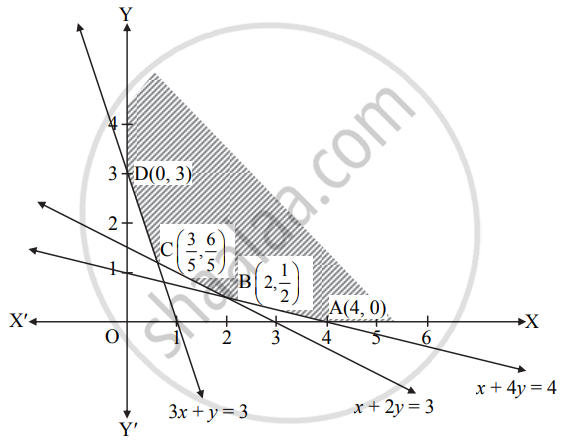
Shaded portion XABCDY is the feasible region, whose vertices are A(4, 0), B, C and D(0, 3).
B is the point of intersection of the lines x + 4y = 4 and x + 2y = 3.
Solving the above equations, we get
x = 2, y = `1/2`
∴ B ≡ `(2, 1/2)`
C is the point of intersection of the lines x + 2y = 3 and 3x + y = 3.
Solving the above equations, we get
x = `3/5`, y = `6/5`
∴ C ≡ `(3/5, 6/5)`
Here, the objective function is Z = 6x + 21y
∴ Z at A(4, 0) = 6(4) + 21(0) = 24
Z at B`(2, 1/2) = 6(2) + 21(1/2)`
= `12 + 21/2`
= `45/2`
= 22.5
Z at C`(3/5, 6/5) = 6(3/5) + 21(6/5)`
= `18/5 + 126/5`
= `144/5`
= 28.8
Z at D(0, 3) = 6(0) + 21(3) = 63
∴ Z has minimum value 22.5 at B`(2, 1/2)`.
∴ Z has minimum value 22.5 when x = 2 and y = 0.5.