Advertisements
Advertisements
Question
Medians CM and BN of ΔABC are produced to P and Q respectively such that CM = MP and BN = NQ. Prove that the points P, A, Q are collinear and PA = AQ.
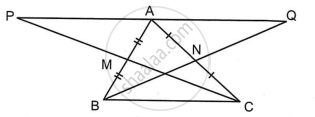
[Hint: Join MN.MN = `1/2` PA and || to PA in ΔCAP, MN = `1/2` AQ and || to AQ in ΔBAQ, etc]
Advertisements
Solution
Given:
- ΔABC is a triangle with medians CM and BN,
- M is the midpoint of AB,
- N is the midpoint of AC,
- The medians CM and BN are extended to points P and Q, respectively, such that:
- CM = MP,
- BN = NQ.
We need to prove:
- The points P, A and Q are collinear.
- PA = AQ.
Step 1: Use of the centroid property
In a triangle, the medians meet at the centroid G, which divides each median into two parts in the ratio 2 : 1, with the longer segment being closer to the vertex.
Thus, the centroid G divides:
- CM such that CG = `2/3` × CM and GM = `1/3` × CM,
- BN such that BG = `2/3` × BN and GN = `1/3` × BN.
Step 2: Extend the medians to points P and Q
We are given that CM = MP and BN = NQ, meaning the points P and Q are such that:
- P is on the line through C and M and the length of segment MP is equal to the length of segment CM,
- Q is on the line through B and N and the length of segment NQ is equal to the length of segment BN.
Step 3: Investigating the relationship of the points P, A and Q
Since CM = MP and BN = NQ, the points P and Q are reflections of M and N across the centroid G. Therefore, the centroid G lies on the line joining P and Q and it divides this line segment in a 1 : 1 ratio.
Thus, points P, A and Q are collinear because G divides PQ symmetrically and lies along the line joining these points.
Step 4: Prove that PA = AQ
Since G is the centroid of triangle ABC and it divides the line segment joining P and Q symmetrically, we have:
- PA = AQ, as the centroid divides the segment joining the points P and Q into two equal lengths.
