Advertisements
Advertisements
Question
Match the examples of changes in List I with the correct type of change in List II.
| List I | List II |
| 1. Burning of paper | A: Physical change |
| 2. The ringing of an electric bell | B: Chemical change |
| 3. Curdling of milk | |
| 4. Electric light is switched on | |
| 5. Melting of butter |
Advertisements
Solution
| List I | List II |
| 1. Burning of paper | B: Chemical change |
| 2. The ringing of an electric bell | A: Physical change |
| 3. Curdling of milk | B: Chemical change |
| 4. Electric light is switched on | A: Physical change |
| 5. Melting of butter | A: Physical change |
APPEARS IN
RELATED QUESTIONS
Which of the following are chemical changes?
- Growth of a plant
- Rusting of iron
- Mixing of iron fillings and sand
- Cooking of food
- Digestion of food
- Freezing of water
- Burning of candle
Write short answer.
Give two examples of periodic changes
Classify the following changes as physical or chemical:- photosynthesis in plants
State whether the following is physical or chemical changes.
respiration in living beings —
True or false
In a physical change no net energy change is involved.
Tick the most appropriate answer.
Photosynthesis requires
Solve this crossword by using the clues that follow-
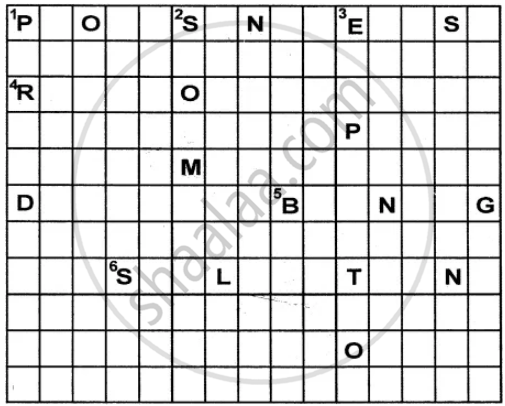
Across
1. Energy in the form of sunlight is absorbed by the green plants in this process.
4. The reddish-brown substance formed over iron in the presence of oxygen and moisture.
5. This change is permanent and irreversible.
6. The process in which a solid directly changes into gaseous state.
Down
1 . It is the change that takes place in case of swinging pendulum of a clock. –
2. Occurrence of this is a non-periodic change as well as a natural change.
3. It is a physical change.
Select the chemical changes from the following list of changes
Butter turning rancid
Name the following.
A form of energy required for a chemical change.
______ is the Universal Solvent.
