Advertisements
Advertisements
Question
Is the following statement true or false :
A rocket can propel itself in a vacuum.
Advertisements
Solution
The given statement is true. A rocket propulsion system works on the principle of conservation of momentum.
APPEARS IN
RELATED QUESTIONS
Explain, why is it difficult for a fireman to hold a hose, which ejects large amounts of water at a high velocity.
A stone of 1 kg is thrown with a velocity of 20 m s−1 across the frozen surface of a lake and comes to rest after travelling a distance of 50 m. What is the force of friction between the stone and the ice?
Using a horizontal force of 200 N, we intend to move a wooden cabinet across a floor at a constant velocity. What is the friction force that will be exerted on the cabinet?
According to the third law of motion, when we push on an object, the object pushes back on us with an equal and opposite force. If the object is a massive truck parked along the roadside, it will probably not move. A student justifies this by answering that the two opposite and equal forces cancel each other. Comment on this logic and explain why the truck does not move.
A girl weighing 25 kg stands on the tloor. She exerts a downward force of 250 N on the floor. What force does the floor exert on her ?
If action is always equal to reaction, explain why a cart pulled by a horse can be moved.
Do action and reaction act on the same body or different bodies ? How are they related in magnitude and direction ? Are they simultaneous or not ?
According to the third law of motion, action and reaction
Consider a frame that is made up of two thin massless rods AB and AC as shown in the figure. A vertical force `vec"P"` of magnitude 100 N is applied at point A of the frame.
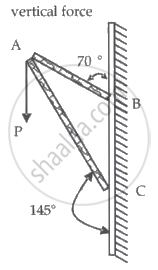
Suppose the force is `vec"P"` resolved parallel to the arms AB and AC of the frame.
The magnitude of the resolved component along the arm AC is xN.
The value of x, to the nearest integer, is ______.
[Given: sin(35°) = 0.573, cos(35°) = 0.819, sin(110°) = 0.939, cos(110°) = –0.342]
A book is resting on a table. Which of the following is the correct reaction force to the gravitational pull of the Earth on the book?
