Advertisements
Advertisements
Question
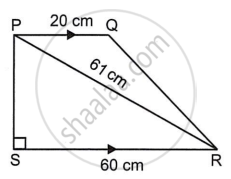
In trapezium PQRS, PQ = 20 cm, PR = 61 cm, SR = 60 cm and PS ⊥ SR. Find its area.
Advertisements
Solution
Given:
- In trapezium PQRS,
- PQ = 20 cm
- PR = 61 cm ...(Diagonal)
- SR = 60 cm
- PS ⊥ SR ...(PS is perpendicular to SR)
Stepwise calculation:
1. Since PS is perpendicular to SR, PS is the height of the trapezium when SR is taken as the base.
2. Use Pythagoras theorem in right triangle PSR to find PS:
PR serves as hypotenuse, SR and PS are perpendicular sides.
PR2 = PS2 + SR2
Given PR = 61 cm, SR = 60 cm,
So calculate PS:
612 = PS2 + 602
3721 = PS2 + 3600
PS2 = 3721 – 3600 = 121
PS = `\sqrt(121)`
PS = 11 cm
3. Now, find the length QR other parallel side by subtracting PQ from PR’s horizontal projection.
Since PS is the height, project PQ and QR on the same line SR to get their bases.
4. The area of trapezium is given by:
Area = `1/2` × (PQ + SR) × PS
Using values:
= `1/2 xx (20 + 60) xx 11`
= `1/2 xx 80 xx 11`
= 40 × 11
= 440 cm2
The area of trapezium PQRS is 440 cm2.
